
Stove
Sparking
A bright flash, a crackle or a shower of sparks comes from a coil burner, from under the glass, from the oven element or from behind the stove, sometimes with a pop and a burnt smell.
Mon–Sat, 8am–8pm
- Gas, fire, sparks or a burner stuck on
- 5 questions that narrow it
- 6 causes, cheapest first
Book a visit
Three short steps, about a minute.
or call (844) 415-7620
Loading appointment form…
The appointment form couldn’t load. Please try again.
If there is gas in the air, walk out first. Without gas, shut the stove's breaker off
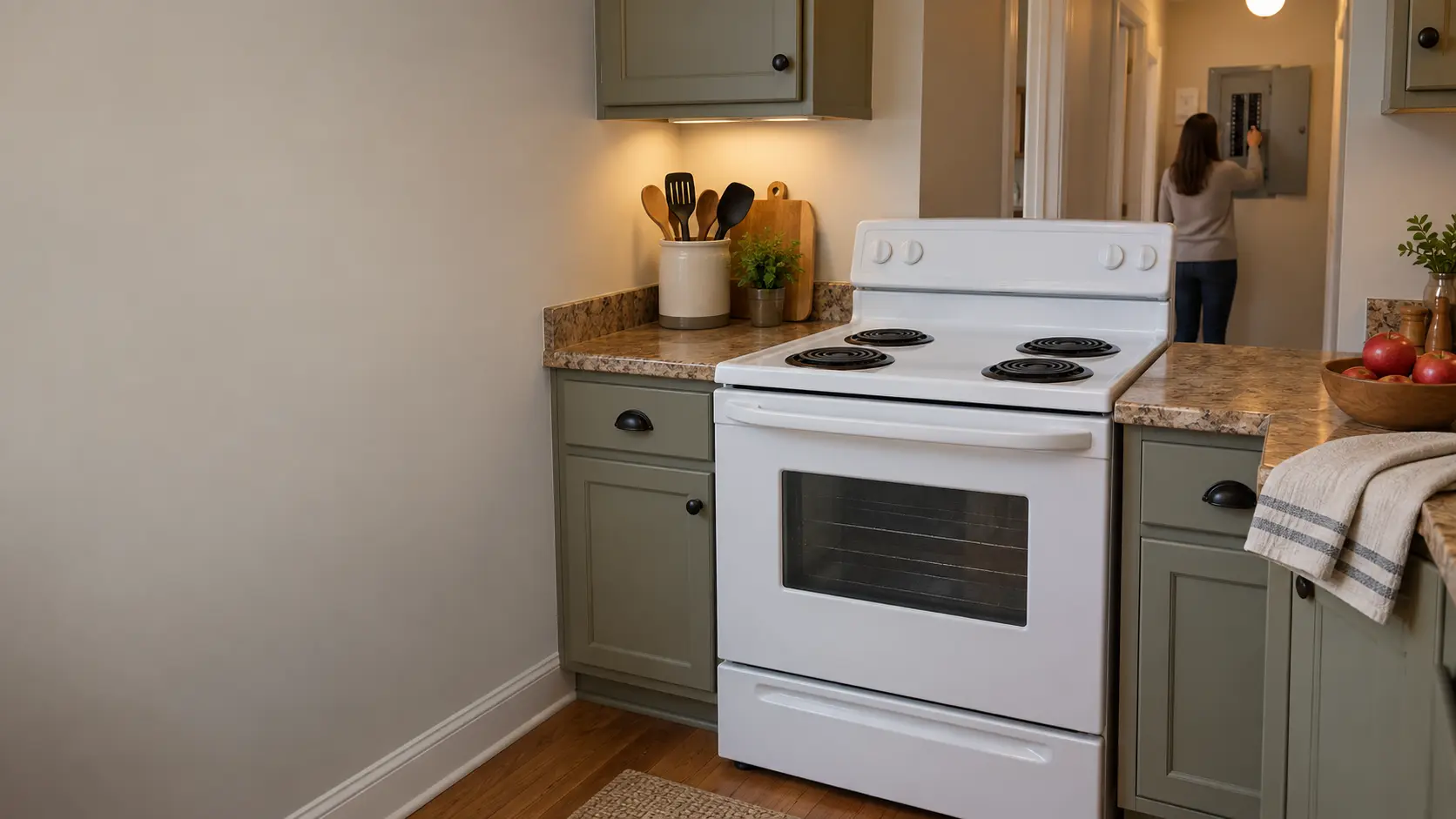
Sparks from an electric stove are an emergency because the arc can ignite grease, food or the wiring. Cut power at the breaker only if you can reach the panel without going near the stove; otherwise leave the house and call 911. Keep the stove off until it has been looked at.
What it
usually means.
An electric stove carries 240 volts to every burner and to the oven. When that current jumps through air instead of running through the heating wire, you see it as a spark. The usual places are a coil burner that is not pushed fully into its socket, a coil or oven element whose metal skin has split, a socket that has burnt at its contacts, and the thick cord or wires where the stove connects at the back. A single blue flicker from a gas igniter is how a gas stove lights and is not this problem. Sparks from the burners, the oven or the back of an electric stove mean current is going somewhere it should not, and the heat at that point can start a fire.
 The 6 causes, cheapest first
Answer these first
Where did the sparks come from: a coil on top, under the glass, inside the oven, or behind the stove?
Did the spark come with a loud pop, after which that burner or the oven stopped heating?
Is there aluminum foil in the drip pans, lining the oven floor or wrapped around a burner?
Was a coil burner lifted out for cleaning and pushed back in shortly before?
Is the stove still sparking now, or did it happen once and stop?
Check these
before you book.
Stove sparking: 5 checks, and none of them costs anything.
Do not touch the stove, turn its knobs or reach across it while it is sparking.
If you can get to the main electrical panel without passing the stove, switch off the stove's breaker; if you cannot, get everyone out of the house and call 911.
If the sparks have started a flame, keep the oven door shut or slide a lid onto a burning pan, and never use water; if it keeps burning, leave and call 911.
Also worth checking
- With the breaker off and the stove cold, remove any foil and look for a coil sitting crooked or a burner with a split or bulge in it.
- Leave the breaker off until the stove has been repaired, and tell us where the sparks came from when you book.
The causes,
cheapest first.
6 things stove sparking turns out to be, from foil touching a burner or element to loose power connection at the back of the stove.
The cost guide-
01 no repair
Foil touching a burner or element
Foil drip-pan liners, a sheet on the oven floor or foil folded around a coil can touch a live terminal and arc. Once the stove is off and cold, take all foil out and use the stove the way the manual shows, without liners.
-
02 low
Coil burner not seated in its socket
A coil pushed back in at an angle makes a loose contact that arcs and burns the terminals. If the terminals are now pitted, the coil and often the socket need replacing together.
-
03 low
Coil burner split along its surface
A coil can blister, crack or bulge at one spot after years of heat or a boil-over, and current escapes through the break with a flash. The coil will not work again after this.
-
04 low to moderate
Oven element burning through
The bake or broil element in the oven can split with a bright arc and a pop, sometimes leaving a glowing spot along its length before it goes dark. The oven stops heating on that element afterward.
-
05 low to moderate
Burnt socket or wire under the stovetop
The socket a coil plugs into, and the short wires behind it, can scorch after a loose connection has been heating them for months. Sparks then come from underneath the burner rather than from the coil itself.
-
06 moderate
Loose power connection at the back of the stove
Where the cord or cable joins the stove, screws can loosen after a move or an old installation, and the terminal block burns. Sparks or smoke from behind the stove point here.
What else
it could be.
Most often confused with stove smoking, then stove shocks when touched.
All problems


The makes
it happens on.
32 makes on this site; stove sparking can show up on any of them. Each mark opens that make's own page.
All 32 brandsStove Sparking,
where we come out.
9 metros, each with its own page.
All service areasTampa BayFL · 31 areas
Miami / South FloridaFL · 47 areas
New York MetroNY · 75 areas
HoustonTX · 36 areas
ChicagoIL · 50 areas
Los AngelesCA · 95 areas
San DiegoCA · 31 areas

Questions about
stove sparking.
My gas stove sparks when I turn the knob. Is that dangerous?
Can I keep using the other burners after one sparked?
Why did my oven flash and pop, then stop heating?
Is it safe to line drip pans with foil to keep them clean?
Back to your everyday
Still seeing stove sparking?
Book with what you checked above — 5 answers save the technician the first part of the visit.