

Gas
Stove Repair
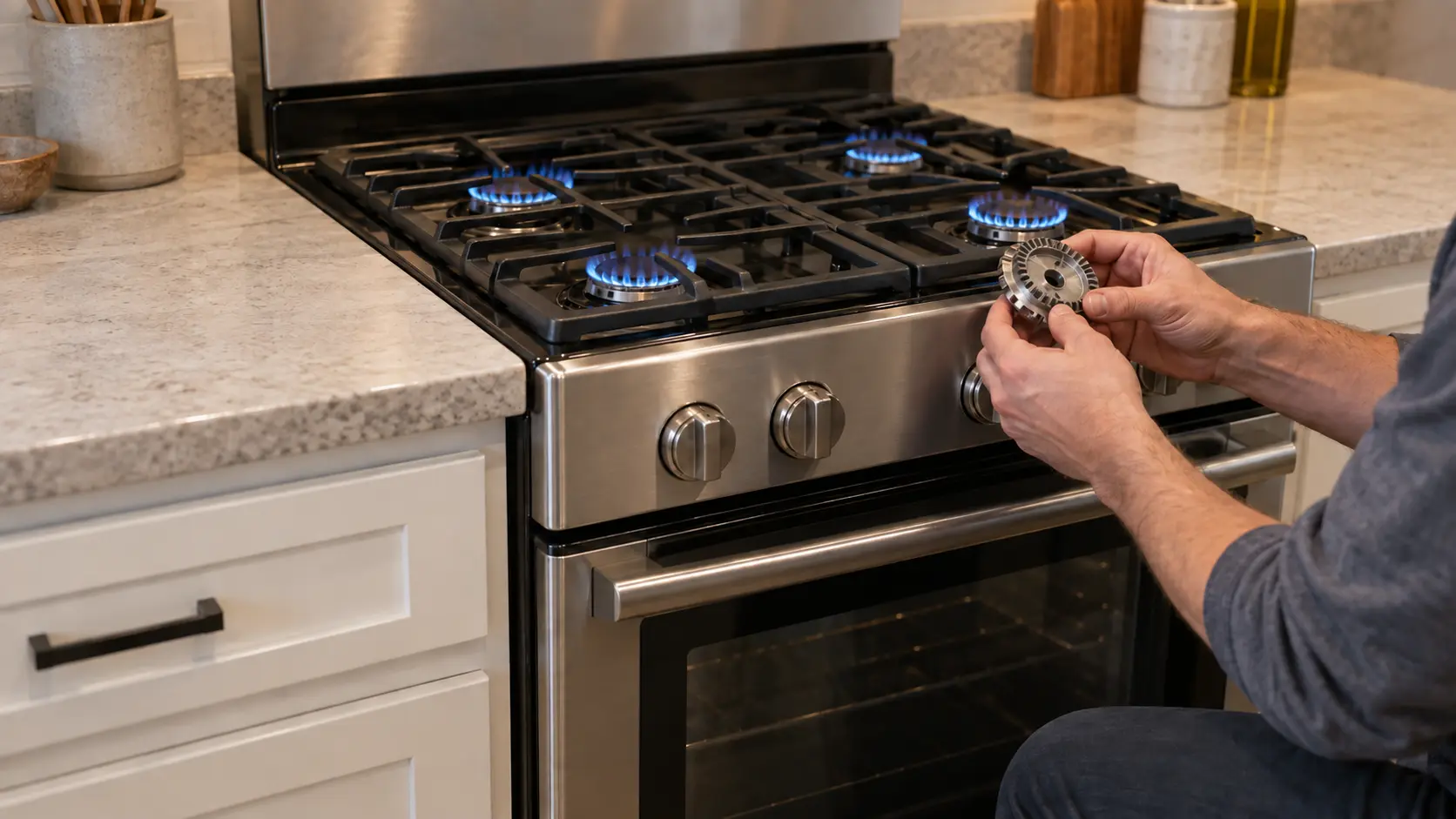
A stove with gas burners on top, whether its oven below runs on gas too or on electricity, fed by one gas line behind it and plugged into a wall outlet for the spark.
Mon–Sat, 8am–8pm
- 4 things that fail on it
- 30 makes build it
- 6 problems it shows
Book a visit
Three short steps, about a minute.
or call (844) 415-7620
Loading appointment form…
The appointment form couldn’t load. Please try again.
Is yours
a gas?
Most people who say gas stove mean the one they cook on every night: blue flames on the stovetop, a knob for each burner and an oven underneath, all in one box that slides between the cabinets. Gas stove repair covers every model with gas burners on top, including the ones whose oven heats with electric elements, because the owner's questions start at the same place: a burner that clicks, a flame that looks wrong, a smell that should not be there. Behind the stove a flexible yellow or stainless line runs from a shutoff valve in the wall or floor, and a cord goes into an ordinary outlet, since the spark, the clock and the oven light all need household current. Almost nothing on a gas stove wears out quickly, which is why most of them are worth fixing for a long time.
 What fails on a gas stove
How to tell
When you turn a knob you hear a quick ticking, and a ring of flame appears under the pot within a few seconds.
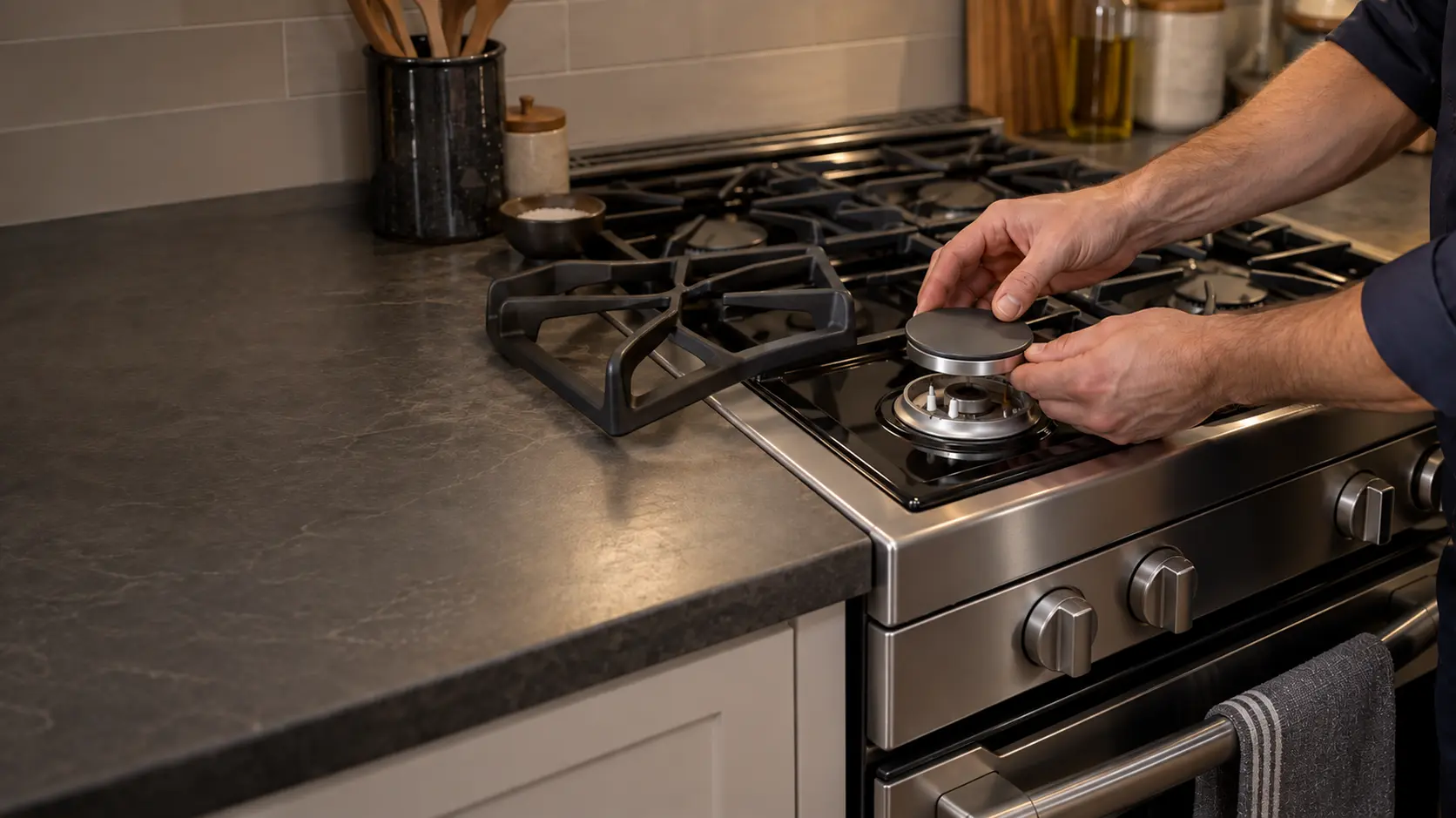
Heavy grates sit over round burner caps, and lifting a grate shows the cap, the burner head and a small white ceramic tip beside it.
Pulling the stove forward a few inches, or looking through the storage drawer opening, shows a gas line and a shutoff valve behind it, next to the power cord.
The model plate, with the gas type printed on it, is usually inside the storage drawer frame or on the oven door edge when the door is open.
What fails
on this design.
On a gas stove: a burner that only ticks, flames that look wrong, the oven part that stays cold, the line behind the stove.
The problems it showsA burner that only ticks
A pot that boiled over or a sponge that dripped leaves water around the ceramic tip, and the spark jumps to the metal instead of the gas. Drying fixes it more often than any part does.
Flames that look wrong
Tall yellow flames, a burner that burns only on one side, or a flame that will not turn down low usually point to a cap sitting crooked, blocked holes in the burner head or a worn valve.
The oven part that stays cold
On an all-gas stove the oven igniter weakens with age and stops opening the gas valve, so the burners on top work while the oven never warms.
The line behind the stove
A connector that was kinked when the stove was pushed back, an old uncoated brass line, or a valve that no longer closes fully are found during a move or a smell check, and they are replaced rather than patched.
Getting at it,
and whether to.
The grates, caps and burner heads come off by hand, so the first look at a gas stove needs no tools and no moving of the stove.
What repairs costOn the visit
- For the gas connection, the spark module or the back of the valves, the stove is slid out from the wall on a protected floor, with the gas turned off at the valve behind it first.
- The oven burner and its igniter sit under the oven floor panel, reached from inside the oven or through the storage drawer opening.
- A slide-in stove tucked under a counter lip, or one with an anti-tip bracket at its back foot, needs a little more care to bring forward.
Repair or replace
A gas stove is one of the easiest appliances in the house to keep going. Igniters, spark switches, burner heads and knobs are small parts, and even a new oven burner or valve rarely comes close to what a new stove plus its hookup would cost. A new one makes more sense when rust has eaten through the oven floor, a slide-in model's control board is no longer made, or you want to move away from gas.
Book a visit for a gas stoveThe problems
it shows.
On a gas stove, most often stove smells like gas.
All problems


Who builds
a gas.
30 of the makes on this site build a gas stove. Each mark opens that make's own page.
All 32 brandsGas stove repair,
where we come out.
9 metros, each with its own page.
All service areasTampa BayFL · 31 areas
Miami / South FloridaFL · 47 areas
New York MetroNY · 75 areas
HoustonTX · 36 areas
ChicagoIL · 50 areas
Los AngelesCA · 95 areas
San DiegoCA · 31 areas

Questions about
gas stoves.
Can I cook on my gas stove when the power is out?
My stove ticks for a few seconds every time I light a burner, then stops. Is that how it should sound?
Is it safe to push my gas stove back against the wall after cleaning behind it?
What should I do if I smell gas near the stove?
Back to your everyday
Is it a gas stove?
Say so when you book — it changes what the technician brings and how the visit is planned.