


Heritage
Stove Repair
Classic stoves built the old way, from AGA cast-iron heat storage stoves to French and Italian enamel stoves with brass trim, kept for decades and repaired rather than replaced.
Mon–Sat, 8am–8pm
- 4 things that fail on it
- 4 makes build it
- 6 problems it shows
Book a visit
Three short steps, about a minute.
or call (844) 415-7620
Loading appointment form…
The appointment form couldn’t load. Please try again.
Is yours
a heritage?
Some stoves are bought to be the center of the kitchen for decades: an AGA that stays warm all day in its cast-iron body, a La Cornue with enamel doors and brass rails made to order, an ILVE or a Bertazzoni from a classic line with heavy grates and dials, or an American stove with open cast-iron burners in the same old style. Their owners call it simply the stove, and they expect it to be fixed, not swapped. Heritage stove repair covers these classic and cast-iron stoves, gas, electric or both, where the work is often the same as on any stove but the parts come from Europe, the doors and trim are heavy, and patience matters. Knowing the model and the year before the visit helps more here than on any other stove, because many parts are ordered for one specific build.
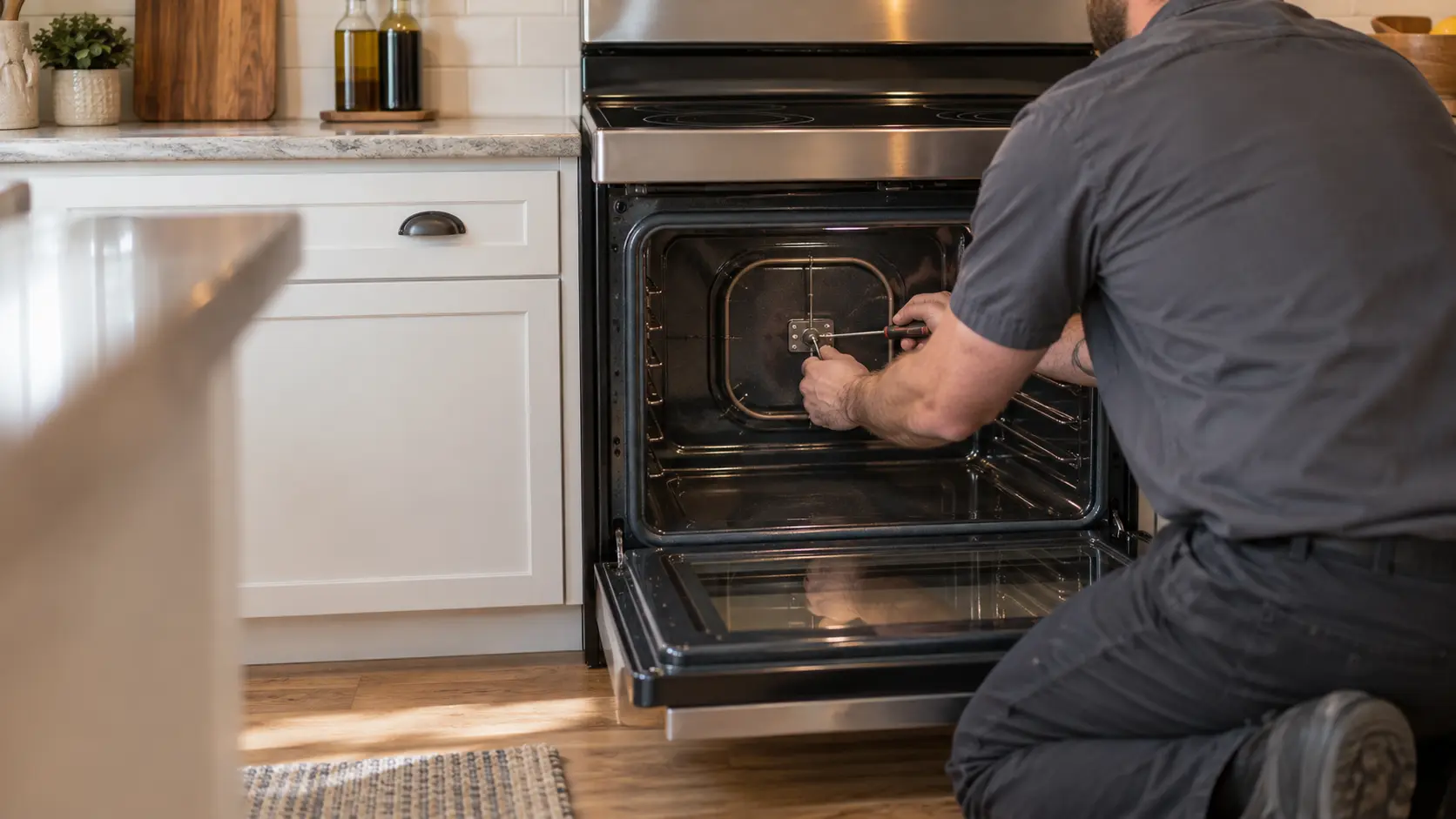 What fails on a heritage stove
How to tell
The body is heavy enamel or cast iron in a color such as cream, deep blue or red, with brass, chrome or nickel rails and knobs.
An AGA or a similar heat storage stove has insulated lids over its hotplates and stays warm even when nobody is cooking.
The oven doors are hinged at the side or open like a vault, and there may be two or more ovens of different sizes.
The model plate, often in French or Italian as well as English, sits behind a door, under a lid or on the back of the stove.
Not yours?Gas stoveElectric stoveInduction stove
What fails
on this design.
On a heritage stove: thermostats and oven temperature, burners, igniters and thermocouples, door seals and heavy hinges, heat storage parts on an aga.
The problems it showsThermostats and oven temperature
Older classic ovens run on mechanical thermostats that drift over the years, so the oven runs hotter or cooler than the dial says and baking changes.
Burners, igniters and thermocouples
Open cast-iron burners and their igniters get the same wear as on any gas stove, and the small flame sensors that keep the gas open weaken with time.
Door seals and heavy hinges
Big enamel doors pull on their hinges and seals, so a door that sags or no longer closes tight lets heat out and marks the enamel around it.
Heat storage parts on an AGA
Cast-iron heat storage stoves have their own set of parts, such as the heating element or burner inside the body, its controls and the insulation around it, which are serviced by the book for that model.
Getting at it,
and whether to.
Tell us the make, the model and roughly the year when you book, and send a photo of the model plate, so the right parts can be found before the first visit.
What repairs costOn the visit
- Heritage stoves are heavy and often set tight into the kitchen, so most work is done in place, from the front and through the doors and panels.
- Enamel and brass are protected with blankets while the stove is opened, and trim comes off in order so it goes back exactly the same way.
- Some imported parts take weeks to arrive, and a heat storage stove is allowed to cool fully before anything inside it is touched.
Repair or replace
A heritage stove is almost always worth repairing: it was chosen to last, its cast iron and enamel outlive any board, and a new one of the same class costs many times more than a thermostat, a hinge or a burner. The real limit is parts, so an older model whose maker no longer supplies a key part may need a matching part from another source or a careful adaptation.
Book a visit for a heritage stoveThe problems
it shows.
On a heritage stove, most often oven on my stove runs hot or cold.
All problems


Who builds
a heritage.
4 of the makes on this site build a heritage stove. Each mark opens that make's own page.
All 32 brandsHeritage stove repair,
where we come out.
9 metros, each with its own page.
All service areasTampa BayFL · 31 areas
Miami / South FloridaFL · 47 areas
New York MetroNY · 75 areas
HoustonTX · 36 areas
ChicagoIL · 50 areas
Los AngelesCA · 95 areas
San DiegoCA · 31 areas

Questions about
heritage stoves.
Is my old enamel stove worth fixing when the oven runs too hot?
My AGA stays hot all day and night. Is it supposed to?
Can parts still be found for a stove that is twenty or thirty years old?
We are moving house. Can a heritage stove come with us?
Back to your everyday
Is it a heritage stove?
Say so when you book — it changes what the technician brings and how the visit is planned.