


Before you commit
Stove
repair cost,
band by band.
Bands rather than prices, because the same repair costs differently on a freestanding unit and on a built-in. What does not change is the order — the cheap causes are also the common ones — or the rule that decides repair against replace.
Mon–Sat, 8am–8pm
- 9 priced jobs
- 5 bands
- Price in writing first
Book a visit
Three short steps, about a minute.
or call (844) 415-7620
Loading appointment form…
The appointment form couldn’t load. Please try again.
Your stove is priced after it has been tested.
The scale on this page is a map of where stove jobs usually land, not a quote for yours. A burner that stays cold might need a coil, a socket, a switch or a single wire; an oven that will not warm might need an element, an igniter, a valve or a sensor. Over the phone those look the same. So the stove is run and measured first, the price is set once the failed part is known, and nothing is fitted until you have said yes.
The bands, job by jobAsk about the visit fee while booking, and whether it comes off the repair if you go ahead.
The repair price is given in your kitchen after testing, and work begins only when you agree to it.
When a stove is not worth the money, the technician says so, and that answer is one of the reasons for the visit.
What a repair
usually costs.
When weighing a stove repair, picture the whole bill for a new stove, not the price on the showroom tag: delivery, hauling the old one away, a new gas connector or cord, and a slide-in model that must match the gap and the counter edge you already have. Against that, igniters, coils, sockets, knobs, hinges and oven elements are nearly always worth replacing. A new stove tends to make sense only when a glass top and a control board fail together on an older stove, the board for your model is no longer made, or rust has come through the oven floor.
| Repair | Relative cost | Notes |
|---|---|---|
| Gas burner head, cap, orifice or valve | low to moderate | Cleaning, reseating and adjusting a burner often needs no part. A new head or cap is a small cost, while a burner valve sits higher because the stovetop is opened and every joint is leak-tested afterward. |
| Electrode, spark switch or spark module | low | An electrode or a single spark switch is a small part reached from the top of the stove. A spark module costs a little more and is reached from the back or under the stovetop. |
| Coil burner, socket or drip pan | lowest | Coils, sockets and drip pans are among the least costly parts on any stove. Renewing burned wire ends behind a socket adds a few minutes, not much more. |
| Glass stovetop, element or induction coil | moderate to highest | An element or limiter under the glass stays toward the middle of the scale. A whole new glass top, made for one model, is one of the costliest jobs a stove can need, and more so on an induction stove. |
| Oven element, igniter, gas valve or sensor | low to moderate | A bake or broil element and a temperature sensor are modest parts fitted from inside the oven. A gas oven igniter sits in the middle, and a gas safety valve comes out higher. |
| Knob, stem or burner switch | low | A knob on its own is minor. A switch behind a knob takes a short job with the power off, and scorched wire ends on it are renewed during the same visit. |
| Control board, keypad or display | moderate | A reseated connector or a cleared lock costs little. A keypad or a display board lands in the middle, and an induction power board pushes the job toward the top of the scale. |
| Oven door hinges, seal or lock | low | Hinges are replaced in pairs and a seal clips in, both from the front of the stove. A door lock on a self-cleaning stove, or door glass, adds a little more. |
| Gas connector, cord or anti-tip bracket | low | A new connector, cord or bracket is an inexpensive part. Most of the time goes into sliding the stove out safely, leak-testing each fitting and setting it back square. |
What the diagnostic
visit covers.
The first visit decides what the repair actually is. The fee, and whether it is credited against the repair, is said when you book, before anyone comes out.
The diagnostic visitEvery burner lit or switched on from low to high, and the oven run on bake and broil, so the technician sees what you see at home.
The gas valve and connector, or the cord, the outlet and both halves of the breaker, looked at before a single panel is opened.
Electrodes, coils, switches, oven igniters, sensors and boards tested with a meter, so the answer rests on a reading.
A named part, the work it takes and its price, or a straight word that your stove is not worth repairing.
What moves
the price.
Five things decide where in its band a repair lands. None of them is known for certain until a technician has seen the stove.
The typesGas, electric, induction or a heritage stove
Gas work centers on burners, the spark and the line behind the stove, and ends with a leak test. Electric work means coils, sockets, switches and oven elements. Induction adds boards, sensors and a fan, and a heritage stove adds imported parts and heavy doors and trim.
Freestanding or slide-in
A freestanding stove slides out on its own feet once the drawer and bracket are dealt with. A slide-in stove tucks under the counter lip on both sides and takes more care to bring forward and set back without marking the counter.
The part that failed
Coils, knobs, electrodes and hinges sit at the low end. Oven elements, igniters, spark modules and switches are a step up, while glass tops, control boards and induction boards sit at the top.
The make and how fast parts arrive
Parts for the everyday makes are usually stocked and sometimes on the van. Premium and imported stoves can mean costlier parts and waits of weeks, and a board that is no longer made can decide the question by itself.
When a second trip is needed
If a part has to be ordered, the technician comes back to fit it. The model and serial plate usually sits inside the storage drawer frame or along the oven door edge, and a photo of it sent with the booking helps the right part be on hand.
Not every stove
breaks the same way.
A gas stove lights its burners and its oven with a spark, an electric stove heats coils or ribbons under a smooth glass top, an induction stove warms the pan itself through the glass, and a heritage stove such as an AGA or a La Cornue is built of cast iron and enamel to last generations. Pick out the one standing in your kitchen.
All stove types
Gas stove
A stove with gas burners on top, whether its oven below runs on gas too or on electricity, fed by one gas line behind it and plugged into a wall outlet for the spark.
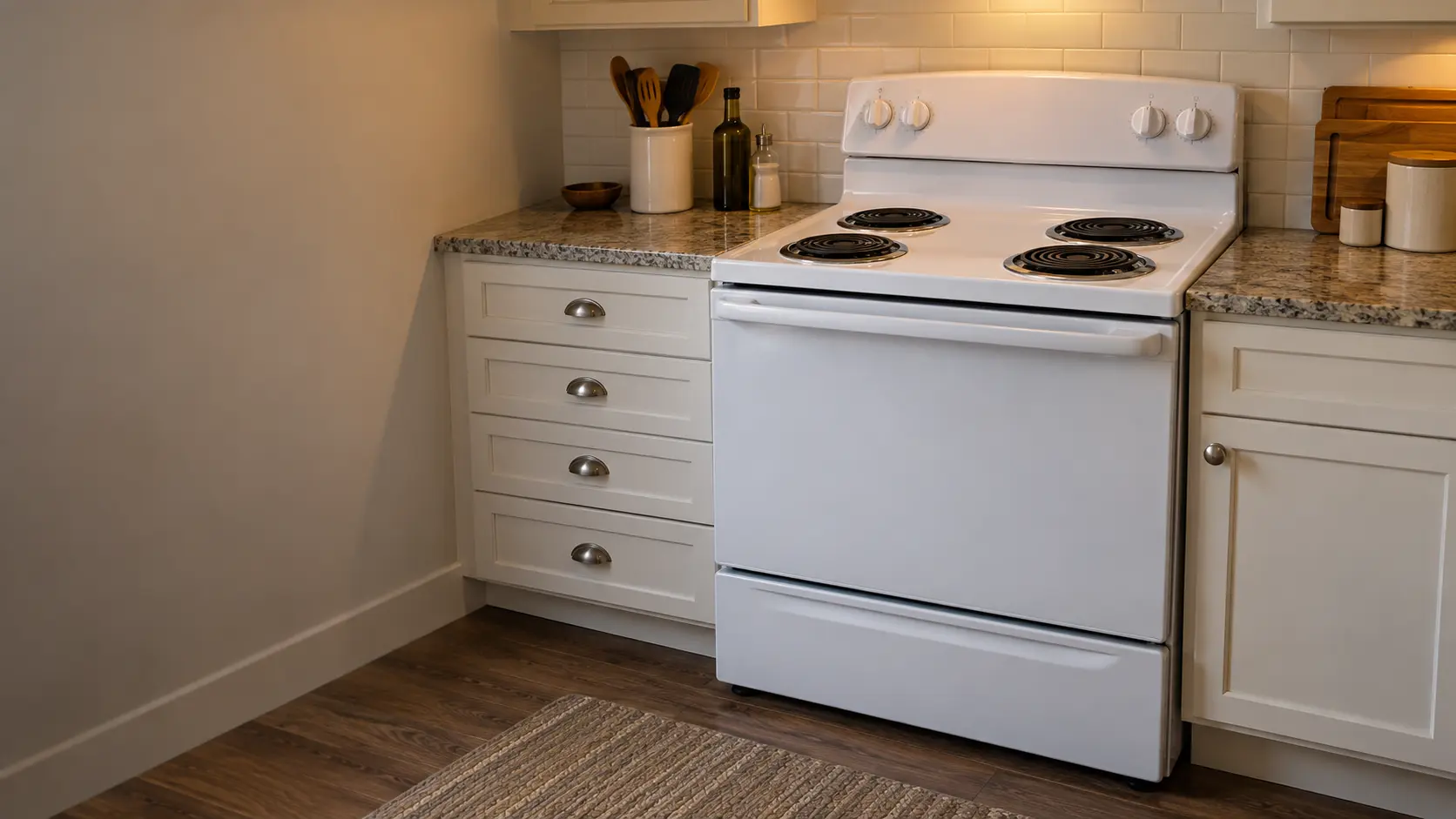
Electric stove
A stove that runs entirely on electricity through a heavy cord and a large outlet behind it, with coil burners that lift out or a smooth glass stovetop with elements under it.

Induction stove
A stove with a flat glass top that heats the pan itself through a magnetic field, run by touch keys and power boards, with an electric oven underneath.

Heritage stove
Classic stoves built the old way, from AGA cast-iron heat storage stoves to French and Italian enamel stoves with brass trim, kept for decades and repaired rather than replaced.
Every kind we serviceAll stoves, side by side
The archive puts the 4 types against each other: how to tell which you own, what fails on each, and which manufacturers build them.
How to tell yoursWhat fails on eachWho makes them Open the type archive
Questions about
the price.
What does the stove diagnostic visit cost?
Why are stove repair costs given as bands instead of prices?
After the diagnosis, am I committed to the repair?
Can the stove repair cost more than I agreed to?
Back to your everyday
Let’s get your stove working again.
Three short steps online, or one call. Tell us what you are seeing and pick a window that works.