


Stove
Flame Too High or Too Low
A gas burner's flame roars higher than it should, sits so low it will not boil water, turns yellow and lazy, or will not stay lit on the lowest setting.
Mon–Sat, 8am–8pm
- 5 checks before you book
- 5 questions that narrow it
- 6 causes, cheapest first
Book a visit
Three short steps, about a minute.
or call (844) 415-7620
Loading appointment form…
The appointment form couldn’t load. Please try again.
What it
usually means.
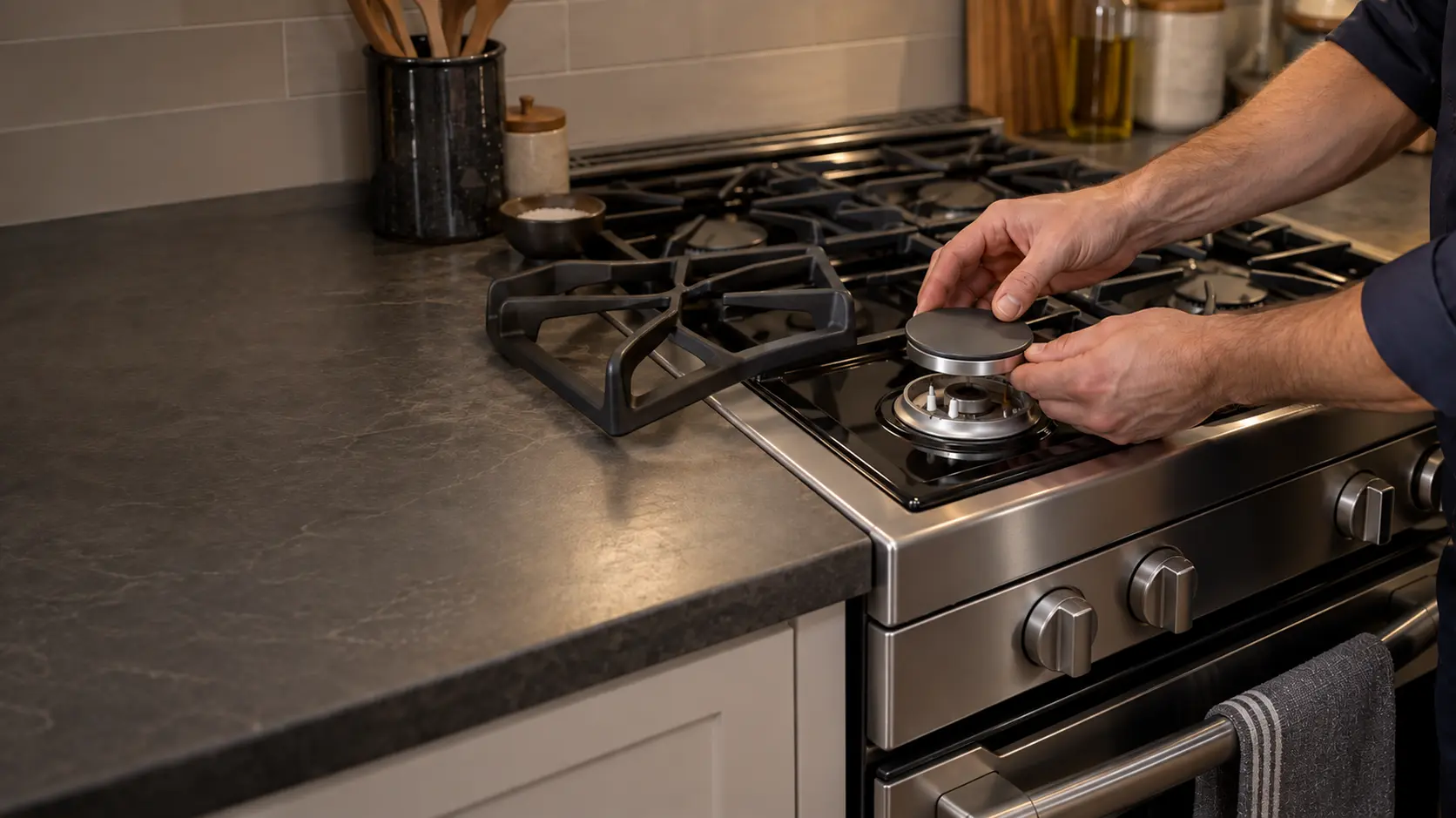
A healthy gas flame is blue with a small, even cone at each port, and it gets smaller or larger smoothly as you turn the knob. The size is set by a small hole called an orifice at the base of each burner, matched to the kind of gas your home uses, plus an adjusting screw for the lowest setting. When a stove set for natural gas is fed propane, or the other way round, every flame is wrong: too tall and yellow, or small and weak. When just one burner acts up, the cause is usually on that burner: a cap sitting off its base, ports clogged by boil-overs, or a low-setting screw that has drifted. A yellow flame that leaves soot on pans is also worth fixing for the air in the kitchen, because it burns less completely.
 The 6 causes, cheapest first
Answer these first
Is it one burner or every burner on the stove?
Is the flame blue, or yellow and floppy with black marks on pans?
Does the burner go out when you turn it to the lowest setting?
Has the stove been moved to a new home, reconnected or converted to propane?
Did it start after cleaning, when the burner parts were taken apart and put back?
Check these
before you book.
Stove flame too high: 5 checks, and none of them costs anything.
If a flame suddenly grows tall and will not turn down, or you smell gas, turn the knob off; if the smell stays, leave the house and call the gas utility from outside.
With the stove off and cold, lift each cap and head, check that each is the right one for its burner, and seat it flat.
Clean out the burner ports and let the parts dry before you light them again.
Also worth checking
- Watch the flame from the side: note whether it is blue or yellow and whether it is even all around.
- Tell us whether the stove has ever been converted or moved between natural gas and propane.
How soon does it need a visit?
A flame that is slightly too high or low can wait for a visit. A flame that will not turn down, a flame that reaches up the sides of the pan or a gas smell needs the knob off at once, and a smell that stays means leaving and calling the gas utility.
The causes,
cheapest first.
6 things stove flame too high or too low turns out to be, from burner cap or head put back wrong to gas pressure problem.
The cost guide-
01 no repair
Burner cap or head put back wrong
After cleaning, a cap that is off center, upside down or on the wrong burner makes an uneven or oversized flame. Match each cap to its burner and set it so it sits flat.
-
02 no repair
Ports clogged with spills
Food in the ports shrinks the flame on one side or all around. Wash the burner head, clear each port with a straightened paper clip and let it dry completely.
-
03 low
Low-setting screw drifted
Behind each knob sits a small screw that sets the lowest flame. If it has moved, the burner can go out on low or refuse to simmer gently.
-
04 moderate
Orifices for the wrong kind of gas
A stove moved from a natural-gas home to a propane home, or the reverse, needs its orifices and regulator changed. Until then every flame is too large or too small.
-
05 moderate
Worn burner valve
A valve that has worn inside may no longer turn down smoothly, jumping from low to high or not reaching a true low setting.
-
06 varies
Gas pressure problem
If every gas appliance in the home has weak or oversized flames, the problem is in the supply or the regulator. That is work for the utility or a gas professional.
What else
it could be.
Most often confused with gas stove won't light, then stove burner not working.
All problems


The makes
it happens on.
32 makes on this site; stove flame too high or too low can show up on any of them. Each mark opens that make's own page.
All 32 brandsStove Flame Too High or Too Low,
where we come out.
9 metros, each with its own page.
All service areasTampa BayFL · 31 areas
Miami / South FloridaFL · 47 areas
New York MetroNY · 75 areas
HoustonTX · 36 areas
ChicagoIL · 50 areas
Los AngelesCA · 95 areas
San DiegoCA · 31 areas

Questions about
stove flame too high or too low.
Why is my stove flame yellow instead of blue?
Should I turn the small screw behind the knob myself?
My burner goes out when I turn it to low. What is wrong?
Does a yellow flame make carbon monoxide?
Back to your everyday
Still seeing stove flame too high or too low?
Book with what you checked above — 5 answers save the technician the first part of the visit.