
Which gas stove jobs are safe for an owner?
Can you fix a gas stove yourself? Only in part: the safe jobs are the ones that involve parts you lift off by hand with the burners cold: grates, burner caps, burner heads and the surface around them. The usual steps for a burner that clicks without lighting are all of this kind, and they cover most real-world cases.
The owner's list
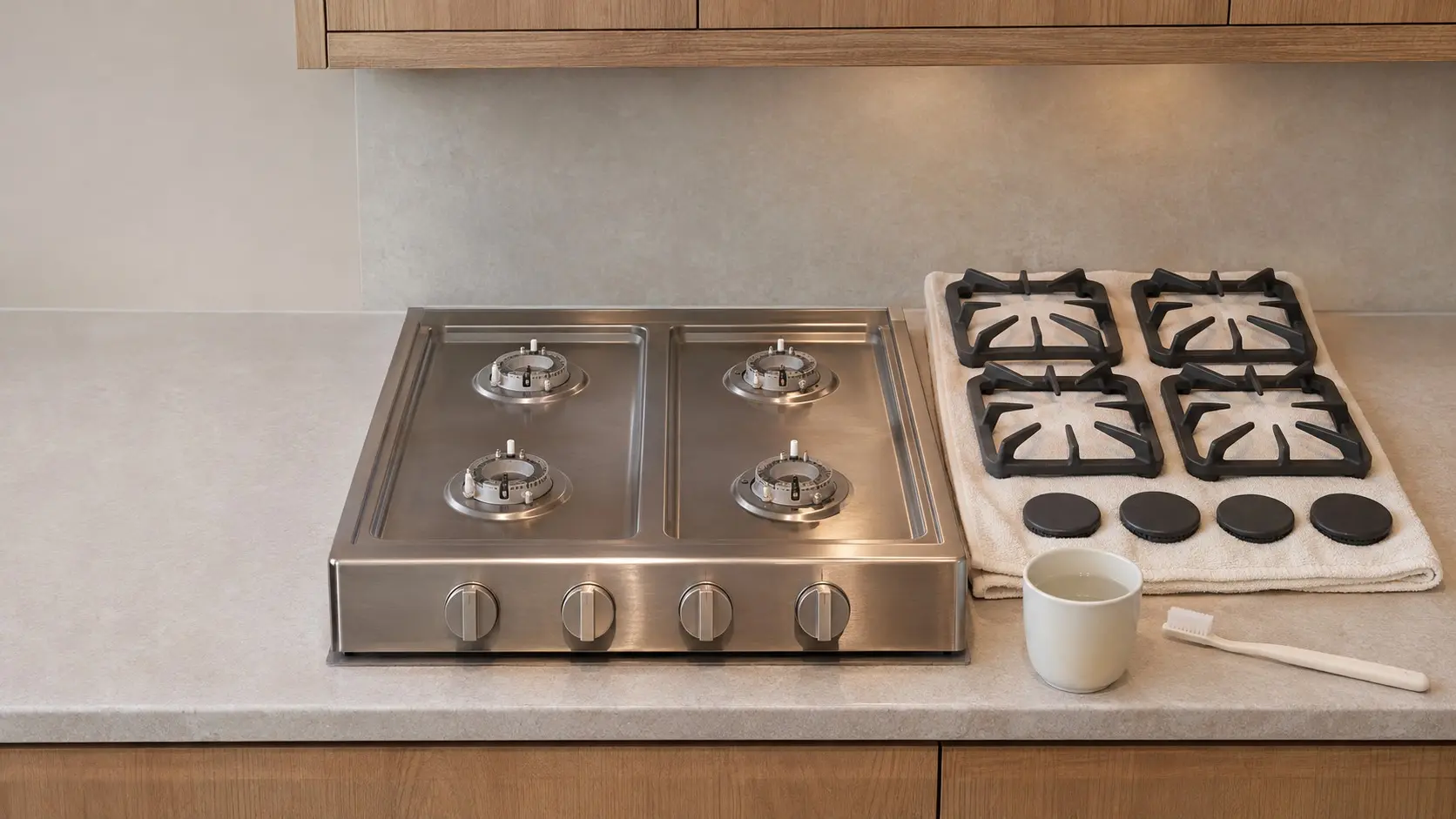
- Cleaning and drying caps and heads.
- Clearing a clogged port or a spill around the ignition port.
- Seating the white ceramic electrode flush with the cooktop.
- Putting each cap back on its own head, flat.
- Checking that the stove is plugged in and the household breaker is on.
Not on the list
Everything that carries gas or sits behind a panel: the flexible connector, the shutoff valve behind the stove, the regulator, the orifices under the burner head, the manifold and the valves behind the knobs. These stay with a technician (a gas and power hookup check covers the connection), and a leak from any of them cannot be seen or felt.
What do you do if the burner clicks but will not light?
Wet or clogged burner parts are the usual cause, and the fix is to clean and dry them. Wet or clogged heads, an electrode that is not seated, and parts that are misaligned or mismatched are the usual causes of continuous clicking with no ignition.
The steps
- Turn all burners off and let them cool completely.
- Disconnect power to the stove before cleaning, as the owner's manual for many models says: switch off its breaker at the panel, or unplug it only if the plug is within easy reach. Never pull the stove out to reach a plug, because moving it can strain the gas connector. Keep water off the controls.
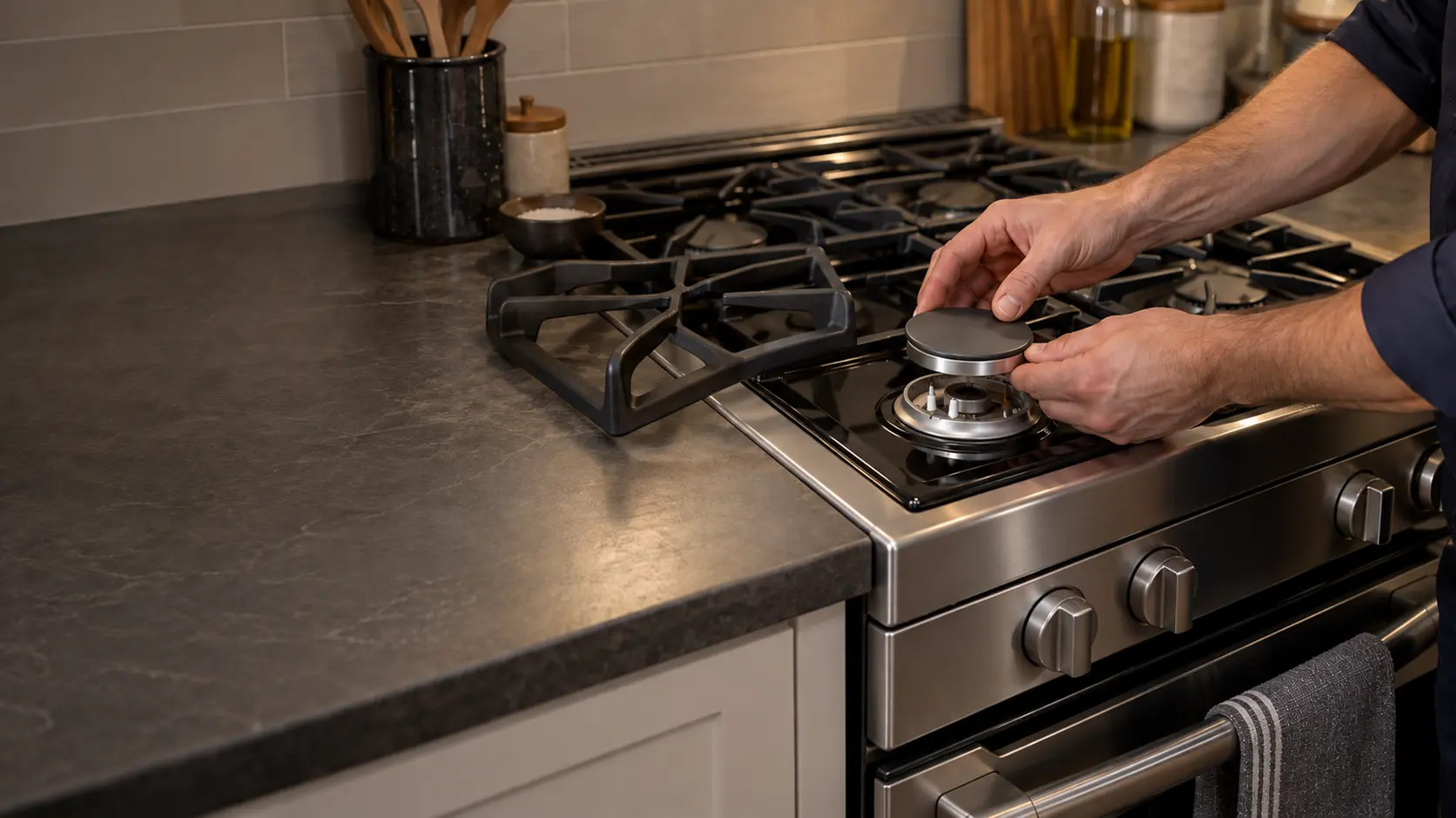
- Lift off the grates, caps and heads.
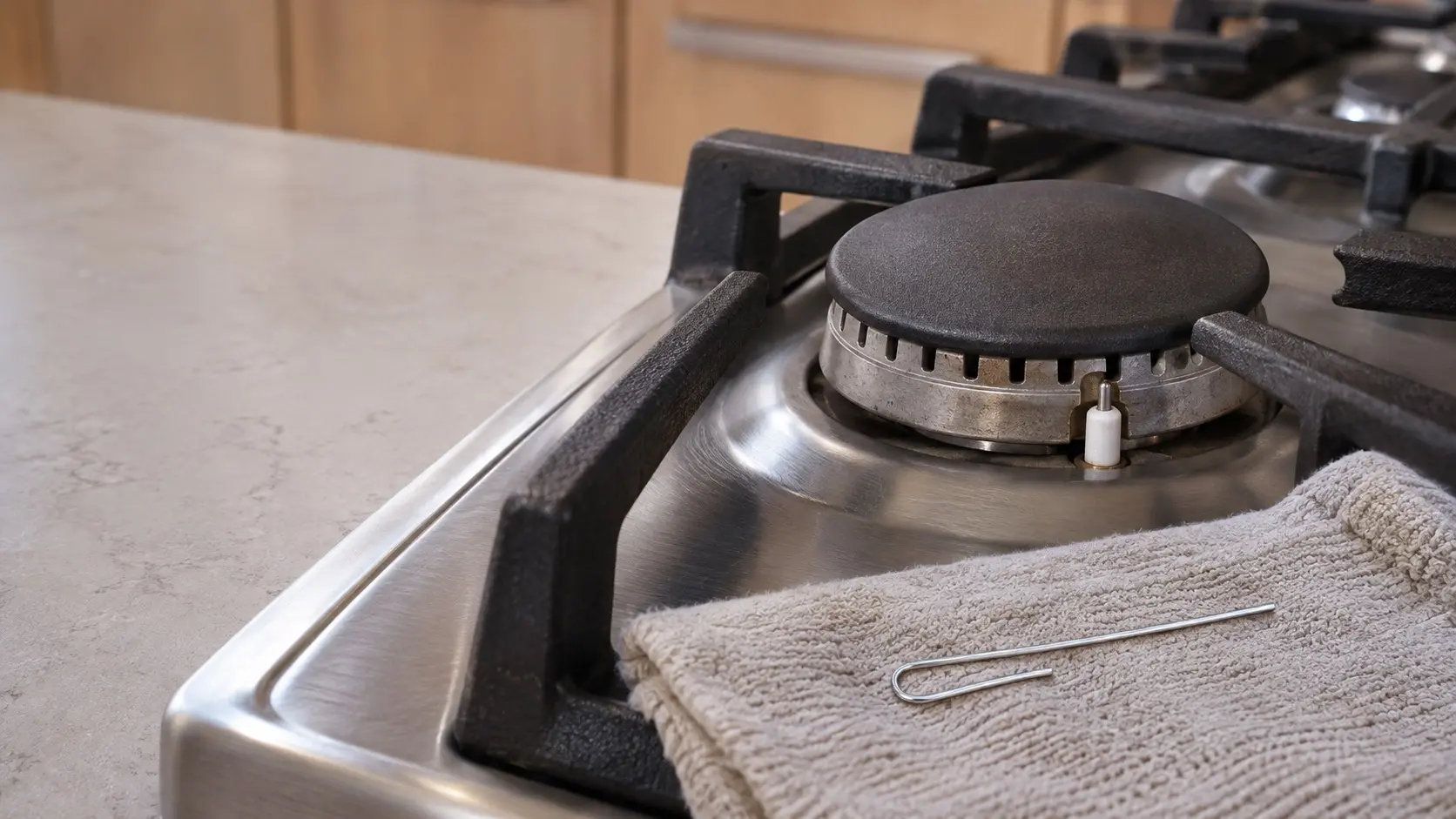
- Clear the ports with a soft brush, or a straightened paper clip if one is stuck, and remove any food from the ignition port.
- Shake out water and let the parts dry fully; air drying works, and some manuals allow a short time in a warm oven.
- If the white ceramic electrode sits raised, press it down with a clockwise twist until it is flush.
- Set each head and cap back in its own position, with the cap flat and secure.
- Restore power and try again. After cleaning, a burner can need a number of clicks before it lights.
Plenty of owners do all of that in one afternoon, on a gas stove or range alike. If it still clicks, see why the stove keeps clicking and a burner that quit after cleaning.
What does a gas smell change?
A gas smell changes everything: stop fixing and get out. Utilities add an odorant that smells like rotten eggs, and a stove burner that is off should not smell of it.
If you smell gas:
- Leave the house at once, with everyone and any pets.
- Do not turn on or off any switch, light, appliance or phone inside; a spark can ignite gas.
- Do not light a match or try to find the leak.
- From outside or a neighbor's home, call the gas utility's emergency line or 911.
Do not return until the utility says it is safe. Treat a smell of gas when you light a burner the same way: turn the knob off, leave if the smell stays, and book a technician rather than trying again. A burner that will not catch after the cleaning steps is also a technician's job. See stove smells like gas.
Where does the line sit for the parts you can see?
| Job | Owner? | Why |
|---|---|---|
| Clean grates, caps, heads | Yes, cold | Removable by hand, no gas parts |
| Clear ports, dry parts | Yes | Water and grease are the common cause |
| Seat electrode, set caps flat | Yes | Part of the usual cleaning steps |
| Replace a burner head or cap | Sometimes | Only with the exact part from the manual |
| Move the stove, touch the connector | No | Can strain the gas line |
| Adjust orifices or flame by drilling | No | Wrong size gives a dangerous flame |
| Gas valve, regulator, shutoff | No | Leak risk, work for a technician |
| Spark module, switch, control board | No | Mains voltage and wiring inside |
Replacing a head or cap is fine if it is the exact part for that burner, because a mismatched cap changes how the flame sits. Never enlarge a port or an orifice to get a bigger flame.
What flame and sound problems need a technician?
A flame that is yellow, lifts off the burner, burns on one side only or pops loudly is a combustion problem rather than a dirt problem, and a cap cleaning will not settle it. A stove that sparks on its own, gives a shock when touched, smells of burning or smokes needs a visit as well, and the shock or sparking one is an electrical problem first.
There is also a plain one: a burner that works after cleaning today but quits each time a pot boils over. That tells you where the water goes, and a burner repair visit will see whether an igniter or spark switch has been damaged by repeated soaking, which is the job of igniter and spark switch repair.
If you cannot tell whether a symptom is dirt or something else, stop. Stopping costs little. A gas leak, or a carbon monoxide problem from a poor flame, can cost a lot more; see stove carbon monoxide and when to worry.


