

Where the ticking comes from
Almost every gas stove sold today lights its burners with an electric spark rather than a standing pilot. Turning a knob to the light position closes a small switch on that knob's valve, the switch wakes a spark module under the top, and the module sends rapid pulses to a white ceramic electrode beside each burner. Each pulse is the click you hear.
GE notes that on its sealed-burner models all the igniters spark at once, because they share one module, while gas flows only to the burner you chose. On older lift-top models with twin burners, one igniter serves two burners on each side. Either way, a chorus of clicks while one burner lights is by design.
Clicking that is normal
A burner can take several tries to catch, and GE says ten or twelve clicks is within normal. Once the flame appears, turning the knob away from the light position should stop the ticking within a second or two. A short burst of clicks when a knob is bumped on its way past the light position is also expected.
Source: GE Appliances — Electric ignition for surface burners — Sealed-burner models spark all igniters together from one module; twin standard burners share an igniter per side; clicking after lighting and setting the knob needs service, with power and gas off meanwhile; GE Appliances — Surface burners sparking — All burners spark when one is turned on, because they operate off one spark control module
Ticking with every knob at off
A stove that clicks by itself, with nothing lit, is almost always responding to one knob's switch being held closed. GE's first check is simple: make sure every knob is turned completely to off and has popped back out. A knob that sits a hair past off, or that was pushed in and did not spring back, can keep its switch closed indefinitely.
If every knob is truly off, think back to the last cleaning or the last pot that boiled over. Liquid that ran down a knob shaft reaches the switch below and can make it tick on and off. GE advises letting the stove dry for a few hours before deciding anything has failed.
Finding the knob that is doing it
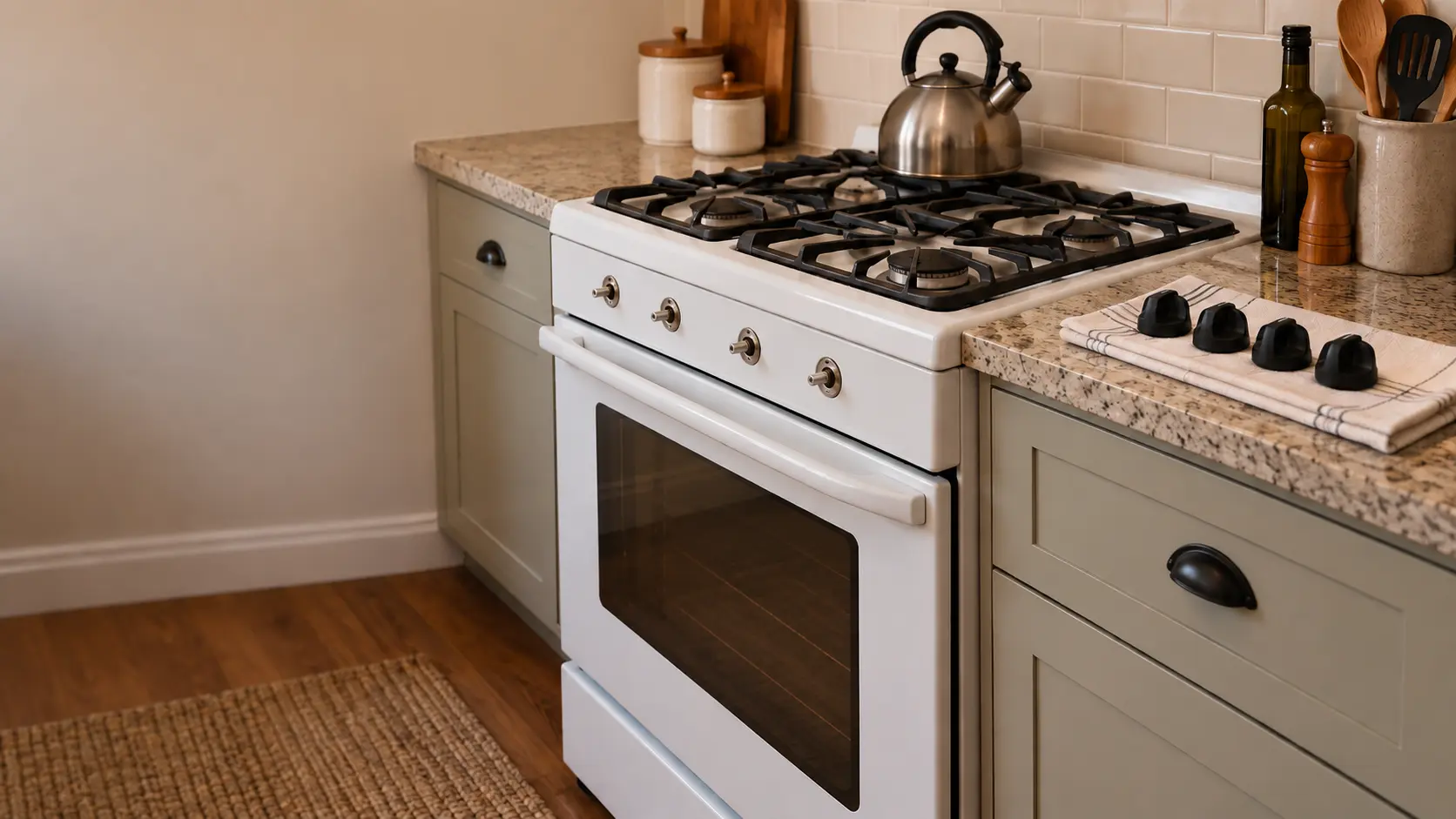
With the stove unplugged or its breaker off, pull the knobs straight off one at a time and look at each shaft and the opening behind it. Sticky residue, crumbs or a film of cleaner around one shaft marks the likely culprit. Wipe the knob and the panel around the opening with a barely damp cloth, dry them, and leave the knobs off for an hour with a fan blowing across the panel before refitting them.
When drying is not enough
A switch that still ticks the next day, after the stove has had a full night to dry, has usually been damaged by liquid or worn out. It is part of the valve or mounted on it, and replacing it means opening the control panel over a live gas manifold. That belongs to a technician.
Source: GE Appliances — One or more burners are clicking — Knob turned completely off and popped back out; moisture after cleaning causes intermittent clicking, let it dry a few hours

Ticking that goes on beside a lit flame
Here the burner lights normally, the knob is turned to a cooking setting, and the clicking carries on. GE is direct about it: if the igniters still click after lighting and turning the knob to a heat position, the stove needs service. Until it is checked, GE advises unplugging the stove or switching off its breaker, and turning the gas off.
Before booking, rule out one thing: a flame that keeps lifting off the burner. A strong draft from an open window, a ceiling fan or a floor fan can push a small flame away from the electrode. Some stoves are built to relight a flame that goes out, and they tick while doing it, so check the owner's manual for whether yours does.
- Only one burner ticks, and only on low: look for a draft or a partly blocked port on that burner.
- All igniters tick with a steady flame on every burner: a switch stuck closed or a spark module problem.
- Ticking comes with a snapping blue spark under the top rather than at the electrode: treat it as a sparking problem and cut the power.
Source: GE Appliances — Electric ignition for surface burners — Sealed-burner models spark all igniters together from one module; twin standard burners share an igniter per side; clicking after lighting and setting the knob needs service, with power and gas off meanwhile
Clicks from the oven half of the stove
A gas oven makes its own sounds, and most are normal. GE lists a clicking in the oven when the gas cycles off and on, and a slight poof as the flame relights, as ordinary behavior. The oven igniter glows while the flame burns and switches off when the oven reaches temperature, so a few clicks every several minutes during baking are the oven holding its heat.
An electric stove can click too. Its elements switch on and off in bursts to hold a setting, and on many models the switching itself makes a soft sound. On an induction stove, a faint tick or hum as a zone pulses at low power is usually the electronics at work.
Oven sounds that mean a service call
GE draws the line clearly. A loud boom, or a door that jumps open as the oven lights, is delayed ignition and needs a technician; the oven should light within two or three seconds. A popping sound as the oven cycles off also needs a qualified technician to judge whether the air setting needs adjusting.
Source: GE Appliances — Gas models: normal operation versus service — Oven clicking and a slight poof as gas cycles are normal; a boom or door blowing open is delayed ignition, the oven should light in 2 to 3 seconds; popping on cycle-off needs a technician; GE Appliances — Radiant burner turns on and off — Radiant elements cycle on and off during operation
What to tell the technician
Clicking problems are intermittent, and they often stop the moment someone arrives. A short phone video with sound, taken while the stove is clicking, is worth more than any description. Note whether the knobs were off, which burners were lit, and whether the ticking started after cleaning, a spill or a power outage.
Include the model number from the plate, usually found on the frame behind the storage drawer or around the oven opening, since switches and spark modules differ between models of the same make.
- Knobs at off or at a setting when it clicked.
- Which burners were lit, and on what flame size.
- Whether it began after cleaning, a spill, a boil-over or an outage.
- How long the clicking lasts and whether it stops on its own.