The ways a stove hurts a small child
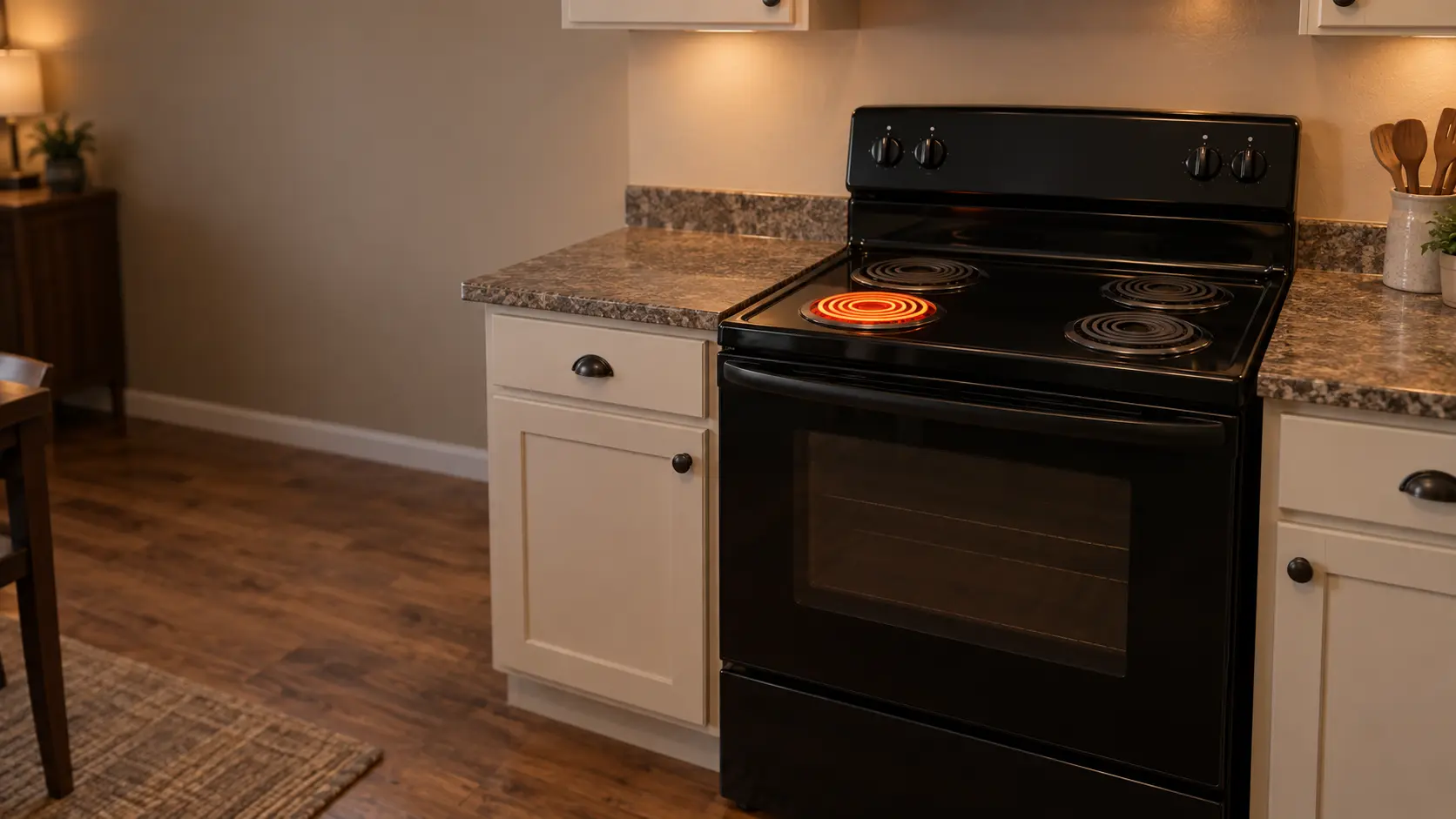
Stove safety with small children starts with the three directions burns come from. From above, a child reaches for a handle and pulls a pot of hot liquid down onto themselves. At hand height, they touch a coil or a glass surface that has gone dark but is still hot, or the glass of the oven door during a long bake. And from the front, a child who climbs onto the open oven door can pull a stove that is not anchored forward and over.
GE's electric stove manual lists the surfaces that can burn: the elements and the areas beside them, the oven vent opening and the edges around the oven door, and it warns that they may be hot enough to burn even when they are dark in color. The same manual says children should never be left alone in an area where the appliance is in use.
- Pot and pan handles sticking out past the front edge of the stovetop.
- Coils and glass that have gone dark but are still hot.
- The oven door glass and the vent opening, during baking and for a while after.
- The burst of hot air and steam when the oven door opens, which GE says can burn hands, face and eyes.
Source: GE Appliances — Owner's Manual, Electric Free-Standing Ranges (49-2000951) — Surfaces may burn even when dark; do not leave children alone near an appliance in use; handles toward the center, not over other units; Lock Controls held three seconds, Cancel/Off stays active; do not store items of interest to children above the stove; check the rear leveling leg under the anti-tip bracket, storage drawer removable on some models; GE Appliances — Owner's Manual, Single Oven Gas Ranges (49-2000316) — Push the control knob in and turn it to the LITE position; stand away when opening the oven door, escaping hot air or steam can burn hands, face and eyes
Drawing a line on the kitchen floor
NFPA's cooking guidance asks for a kid-free zone of at least three feet around the stove and anywhere hot food or drinks are carried. In practice that means a spot where a small child can see you cook without being under your elbows: a high chair pulled back to the table, a play mat by the doorway, or a safety gate across a galley kitchen.
Some families mark the three feet with a strip of colored tape on the floor, which a preschooler understands better than a rule. The same zone applies to the route between the stove and the sink or the table, since a pot being carried is as much of a hazard as one on the burner.
Pets belong outside the three feet too
NFPA puts pets in the same zone, and for a practical reason: a dog underfoot trips the person carrying a pot, and a cat on the counter can nudge a knob. A gate that keeps a toddler out of the cooking area usually keeps the dog out as well.
Source: NFPA — Safety with cooking equipment — Keep a kid-free and pet-free zone of at least three feet around the stove and where hot food or drink is prepared or carried

Handles in, back burners first
CPSC's stove safety sheet asks owners to turn pot handles inward while cooking, and GE's manual adds a detail worth copying: turn the handle toward the center of the stovetop without letting it hang over another burner, where it would heat up or catch. The U.S. Fire Administration gives the same advice so that nobody can bump a handle or pull a pot over.
Whenever the pan fits, cook on the rear burners. A child can reach the front edge of a freestanding stove long before they can reach the back row, and the rear burners also keep hot oil further from a small face.
Source: CPSC — Range Tipover Safety Alert (Publication 5007) — 13 fatalities from 2000 through 2008 from stove, oven and range instability, many children under 10; turn pot handles inward; move tempting items away; no open oven door as a step; check the anti-tip bracket; some makers send a replacement bracket at no charge; GE Appliances — Owner's Manual, Electric Free-Standing Ranges (49-2000951) — Surfaces may burn even when dark; do not leave children alone near an appliance in use; handles toward the center, not over other units; Lock Controls held three seconds, Cancel/Off stays active; do not store items of interest to children above the stove; check the rear leveling leg under the anti-tip bracket, storage drawer removable on some models; U.S. Fire Administration — Cooking fire safety — Turn pot handles toward the back of the stove so no one can bump them or pull them over
Knobs, touch pads and the control lock
Knobs are the part children go for first, and a knob turned even a little can start a burner. On many gas stoves the knob has to be pushed in before it will turn to the lighting position; GE's gas stove manual describes exactly that. It slows a toddler down, but it does not stop a determined four-year-old.
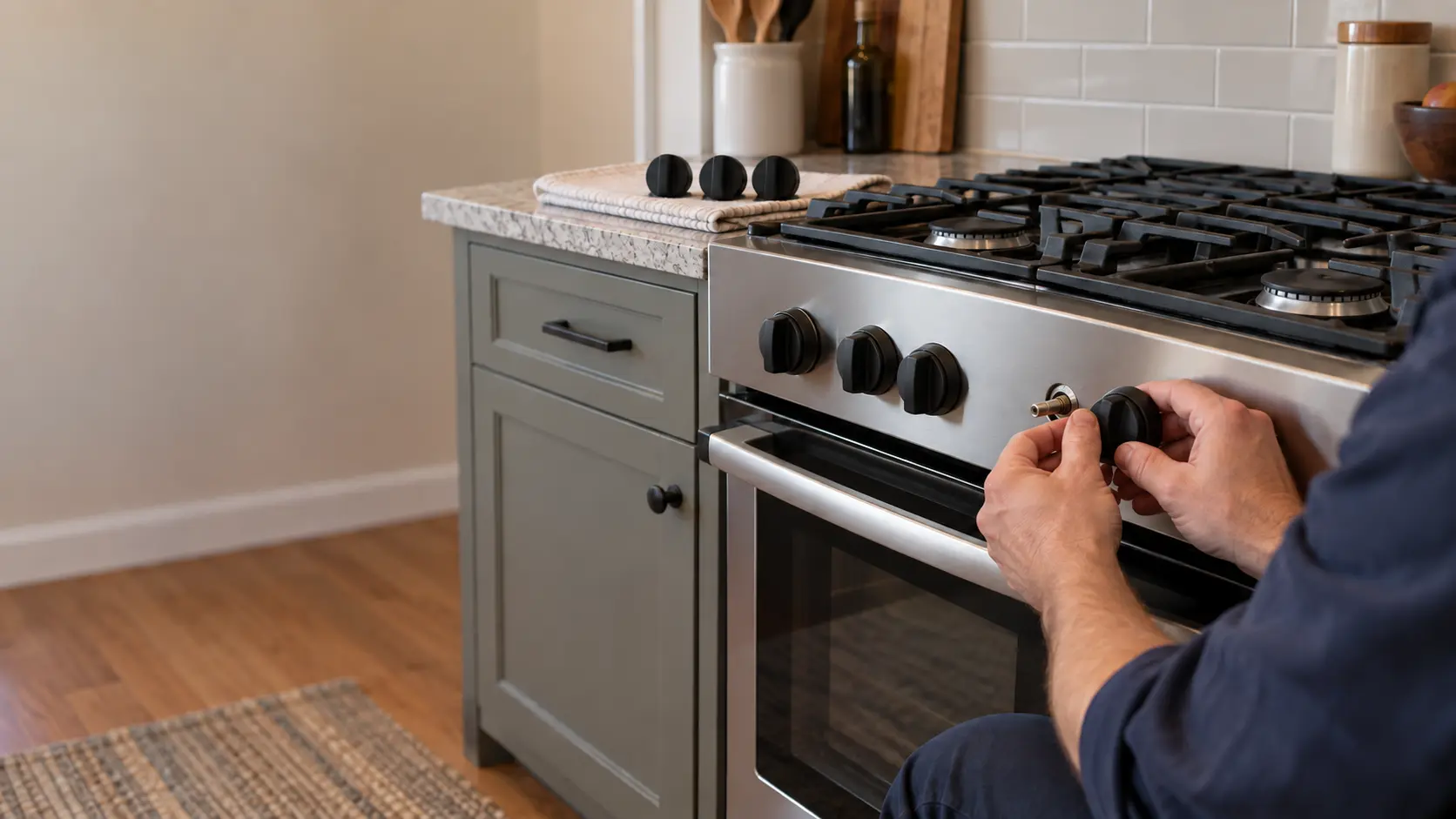
Stoves with an electronic oven control often have a lock that disables the touch pads. On GE's electric models it is called Lock Controls and is held for three seconds to switch it on or off, and the Cancel/Off pad keeps working even while the rest is locked. Knobs on the front of a slide-in stove sit right at a toddler's reach; clip-on knob covers sold for childproofing, or taking the knobs off and keeping them on a high shelf between meals, cover the years when that matters.
- The control lock on the oven touch pads, where your stove has one.
- Clear clip-on knob covers that still let you see where each knob is set.
- Knobs slid off their stems and stored up high between meals, on stoves where they come off.
- A gate or a closed door that keeps a crawling child out of the kitchen when nobody is cooking.
Glass and induction tops look safe when they are not
A smooth glass stovetop gives no glow once it cools below red, and an induction zone does not heat at all by itself, which makes both seem harmless. The pan on an induction zone, and the glass directly under it, still carry the heat of whatever was cooked. Leave the hot-surface light, where your stove has one, as the signal children are taught to respect.
Source: GE Appliances — Owner's Manual, Electric Free-Standing Ranges (49-2000951) — Surfaces may burn even when dark; do not leave children alone near an appliance in use; handles toward the center, not over other units; Lock Controls held three seconds, Cancel/Off stays active; do not store items of interest to children above the stove; check the rear leveling leg under the anti-tip bracket, storage drawer removable on some models; GE Appliances — Owner's Manual, Single Oven Gas Ranges (49-2000316) — Push the control knob in and turn it to the LITE position; stand away when opening the oven door, escaping hot air or steam can burn hands, face and eyes
The oven door, the cabinet above and the anti-tip bracket
CPSC reported 13 deaths from 2000 through 2008 involving the instability and tip-over of stoves, ovens and ranges, many of them children under ten. Its advice is short: move tempting items such as cookie jars away from the stove, never let a child use an open oven door as a step, and make sure the stove is held by its anti-tip bracket. GE adds that items children want should not be kept in the cabinets above the stove at all.
Checking the bracket takes a flashlight. With the oven off and cool, look under the stove at a back corner, or pull out the storage drawer on models where it lifts out, and see whether the rear leveling leg sits under the metal bracket fixed to the floor or wall. If you cannot see it, GE's manual has you slide the stove forward, confirm the bracket is fastened, and slide the stove back until the leg goes under it.
After every pull-out for cleaning
GE asks for the bracket check to be repeated whenever the stove has been pulled away from the wall for any reason. Treat it as the last step of cleaning behind the stove, as automatic as sliding the drawer back in.
Source: CPSC — Range Tipover Safety Alert (Publication 5007) — 13 fatalities from 2000 through 2008 from stove, oven and range instability, many children under 10; turn pot handles inward; move tempting items away; no open oven door as a step; check the anti-tip bracket; some makers send a replacement bracket at no charge; GE Appliances — Owner's Manual, Electric Free-Standing Ranges (49-2000951) — Surfaces may burn even when dark; do not leave children alone near an appliance in use; handles toward the center, not over other units; Lock Controls held three seconds, Cancel/Off stays active; do not store items of interest to children above the stove; check the rear leveling leg under the anti-tip bracket, storage drawer removable on some models