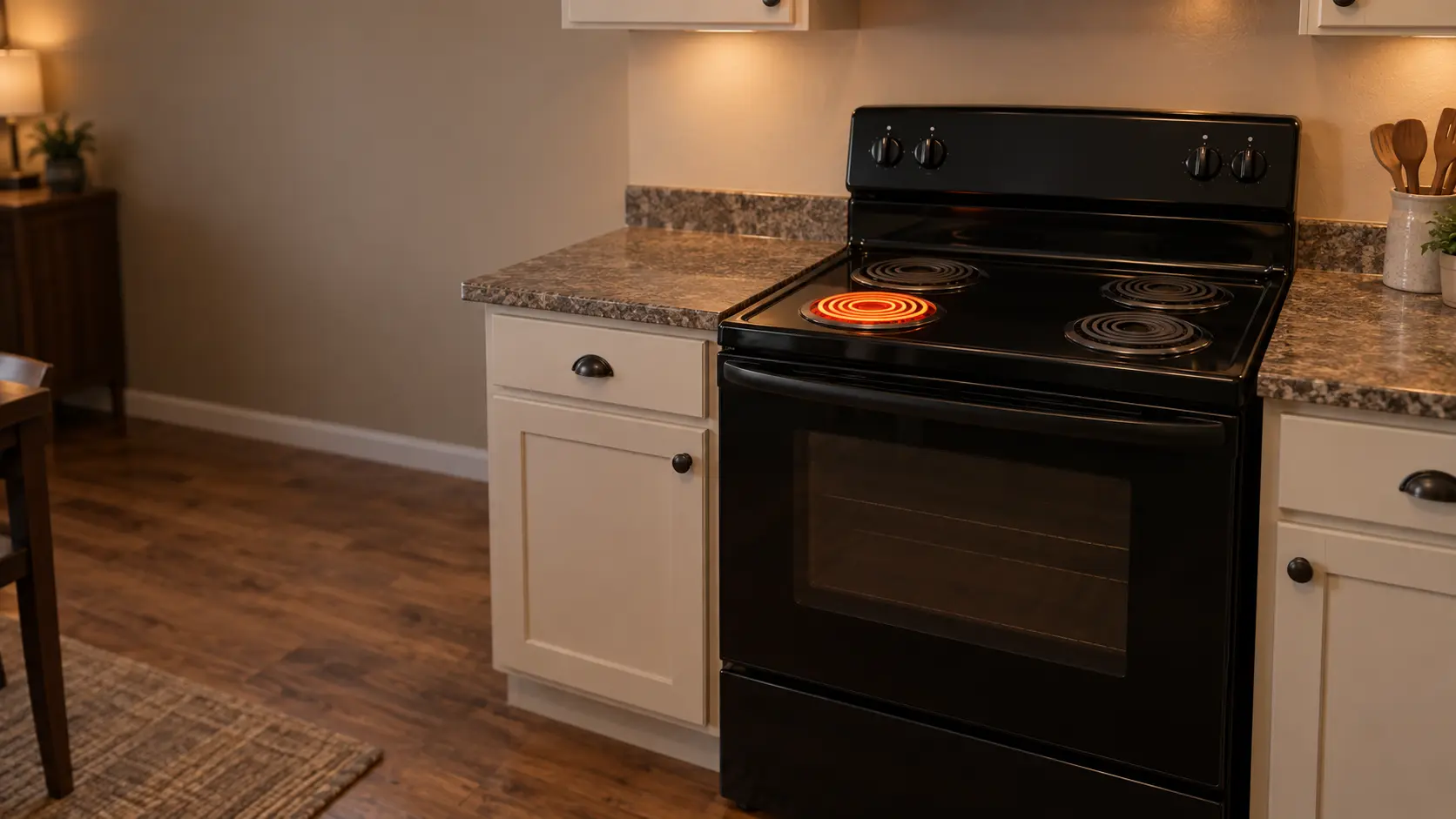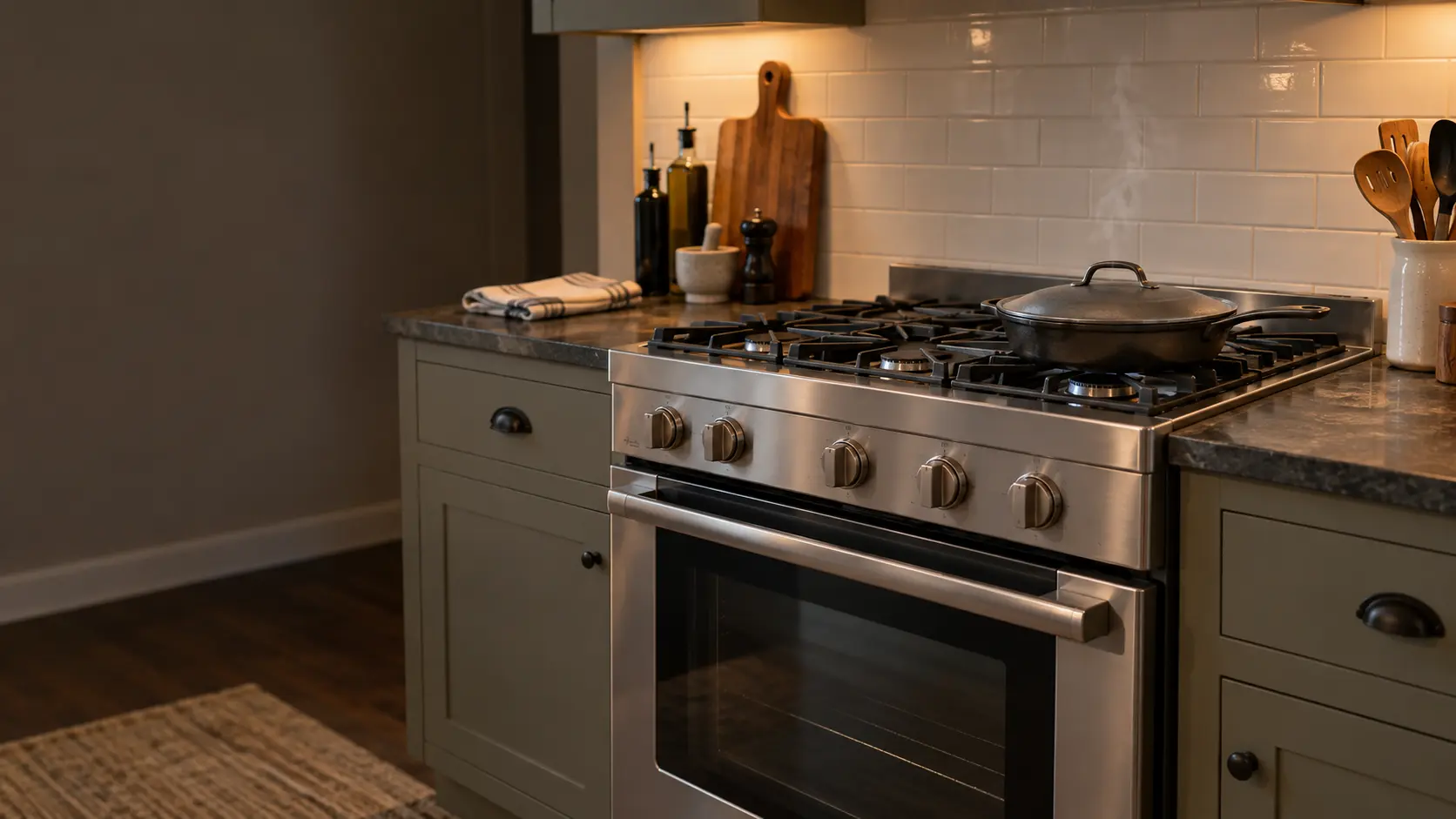


How a pan of oil turns into a fire
A grease fire on the stove does not need a spark to start. Left on high heat, it smokes first, then reaches a temperature at which the vapor above it lights by itself, and from that moment the flame sits on the whole surface of the oil at once. GE's electric stove manual puts the warning in plain terms: oil heated past its smoking point may ignite and spread to the cabinets around the stove, and it suggests a deep-fat thermometer whenever you can use one.
The U.S. Fire Administration counts cooking as by far the leading cause of home fires and home fire injuries, with an estimated 170,000 home cooking fires answered by fire departments in 2021. The factor it names most often is equipment left unattended. That is why the first line of its advice has nothing to do with extinguishing anything: stay with the pan, and if you leave the kitchen, turn the burner off.
- Smoke curling off the oil is the last warning; lower the heat or slide the pan off the burner before anything catches.
- Oil that starts to boil or ripple hard is too hot for what you are cooking.
- Food dropped in frozen, with ice on it, makes oil spit onto the burner and the stovetop around it.
Source: U.S. Fire Administration — Cooking fire safety — Cooking is the leading cause of home fires and injuries; about 170,000 home cooking fires in 2021; unattended equipment 37 percent; stand by your pan and turn the burner off when leaving; keep a lid or baking sheet nearby to cover a pan fire; GE Appliances — Owner's Manual, Electric Free-Standing Ranges (49-2000951) — Oil heated past its smoking point may ignite and spread to cabinets; use a deep-fat thermometer; no water on grease fires; never pick up a flaming pan; smother with a well-fitting lid, cookie sheet or flat tray; multi-purpose dry chemical or foam extinguisher; oven fire during baking: close the door and turn the oven off; during self-clean do not force the door; use only dry potholders, damp ones can cause steam burns
Cover the pan first, then turn off the heat
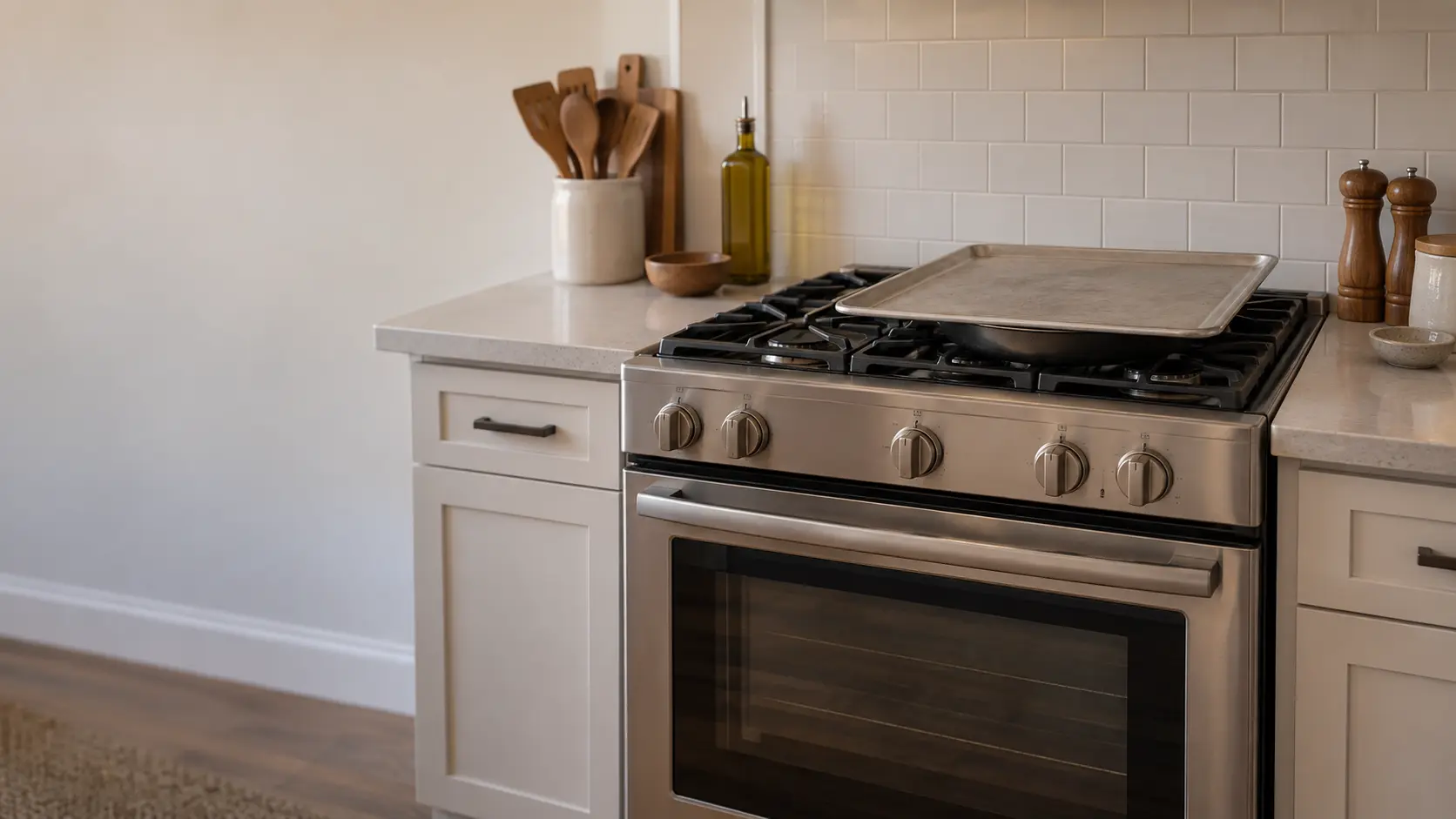
Keep a lid that fits the skillet within arm's reach before the oil goes in; USFA suggests a lid or a baking sheet nearby for exactly this reason. If the oil catches, hold the lid low and slide it across the pan from the side nearest you, rather than dropping it from above, so your forearm never passes over the flame. Then turn that burner off. With the lid on, the fire runs out of air within seconds.
Leave the cover alone afterwards. Lifting it for a look lets air back onto oil that is still hot enough to relight, and a second flare-up is often bigger than the first. Leave it covered until the pan has cooled all the way, which on a heavy skillet can take a good while.
- A lid that fits the skillet you fry in most, kept on the counter beside the stove rather than in a drawer.
- A cookie sheet for pans no lid fits, such as a wide wok or a griddle pan.
- Dry oven mitts; GE warns that damp potholders on hot surfaces can cause steam burns.
- A dry chemical or foam extinguisher mounted near the kitchen exit, reachable without passing the stove.
Gas, coil, glass and induction do not cool alike
On a gas stove the flame under the pan disappears the instant the knob reaches off. A coil or smooth glass element keeps glowing and radiating for minutes after it is switched off, so the pan keeps getting heat from below, and the cover matters even more. An induction zone stops heating the pan when it is switched off, but the pan and the oil in it stay just as hot as they were.
Source: U.S. Fire Administration — Cooking fire safety — Cooking is the leading cause of home fires and injuries; about 170,000 home cooking fires in 2021; unattended equipment 37 percent; stand by your pan and turn the burner off when leaving; keep a lid or baking sheet nearby to cover a pan fire; GE Appliances — Owner's Manual, Electric Free-Standing Ranges (49-2000951) — Oil heated past its smoking point may ignite and spread to cabinets; use a deep-fat thermometer; no water on grease fires; never pick up a flaming pan; smother with a well-fitting lid, cookie sheet or flat tray; multi-purpose dry chemical or foam extinguisher; oven fire during baking: close the door and turn the oven off; during self-clean do not force the door; use only dry potholders, damp ones can cause steam burns; NFPA — Safety with cooking equipment — Slide a lid over a small grease fire, turn off the burner and leave the pan covered until it is completely cool
Water, flour and the walk to the sink
GE's manual lists the two most common mistakes one after the other: do not use water on grease fires, and never pick up a flaming pan. Water sinks under the oil, boils in an instant and lifts burning droplets into the air and onto the cabinets. Carrying the pan toward the sink or the back door sloshes lit oil onto the floor, your clothes and your arms.
Flour and other kitchen powders are not a substitute for a cover either; a cloud of fine flour can burn on its own. A kitchen fire extinguisher is worth owning, and the kind GE's manual names for a burning pan is a multi-purpose dry chemical or foam-type extinguisher. Read its label on a quiet day, because nobody learns the pin and the sweep while a pan is burning.
Using an extinguisher on a burning pan
Stand a few steps back, aim at the base of the flames and sweep from side to side. A blast from close range can push burning oil out over the rim, so distance matters more than speed. If the extinguisher runs empty and the fire is still going, stop and leave the house.
Source: GE Appliances — Owner's Manual, Electric Free-Standing Ranges (49-2000951) — Oil heated past its smoking point may ignite and spread to cabinets; use a deep-fat thermometer; no water on grease fires; never pick up a flaming pan; smother with a well-fitting lid, cookie sheet or flat tray; multi-purpose dry chemical or foam extinguisher; oven fire during baking: close the door and turn the oven off; during self-clean do not force the door; use only dry potholders, damp ones can cause steam burns
Flames inside the oven
A fire that starts in the oven below the stovetop is handled with the door rather than a lid. GE's manual says to smother a fire during baking by keeping the oven door closed and turning the oven off. Opening the door to look feeds it air and brings the flame out toward your face.
During a self-clean cycle the same manual is stricter still: turn the oven off, wait for the fire to go out and do not force the locked door, because fresh air let in at self-clean temperatures can produce a burst of flame. Grease left on the oven floor before a self-clean is the usual fuel, which is why GE asks owners to wipe it out first.
Source: GE Appliances — Owner's Manual, Electric Free-Standing Ranges (49-2000951) — Oil heated past its smoking point may ignite and spread to cabinets; use a deep-fat thermometer; no water on grease fires; never pick up a flaming pan; smother with a well-fitting lid, cookie sheet or flat tray; multi-purpose dry chemical or foam extinguisher; oven fire during baking: close the door and turn the oven off; during self-clean do not force the door; use only dry potholders, damp ones can cause steam burns; GE Appliances — Owner's Manual, Single Oven Gas Ranges (49-2000316) — Leave the appliance and call the fire department; do not attempt to extinguish an oil or grease fire with water; wipe grease out of the oven before self-cleaning
When the fire is bigger than the pan
If flames reach the wall, the cabinet above the stove or anything on the counter, or you cannot get a cover onto the pan, stop fighting it. Get everyone out, shut the kitchen door behind you if one is on your way, and call 911 once you are outside. GE's gas stove manual tells owners to leave the appliance and call the fire department in that situation, and adds in capital letters that an oil or grease fire must not be fought with water.
Fire crews prefer a call about a fire that turned out to be out over a call made ten minutes late. If anyone breathed in smoke or has a burn, say so on the call.
Source: GE Appliances — Owner's Manual, Single Oven Gas Ranges (49-2000316) — Leave the appliance and call the fire department; do not attempt to extinguish an oil or grease fire with water; wipe grease out of the oven before self-cleaning
Checking the stove before the next meal
Once the pan is cold, look at the stove itself. Plastic knobs next to the burner can warp or crack from the heat, a smooth glass top can carry burnt-on oil that needs a scraper and glass cleaner rather than a scouring pad, and a gas burner may have oil in its ports that makes the flame uneven the next time you light it. Soot on the wall behind the stove tells you how high the flames went.
Book a look before using the stove again if a knob no longer turns smoothly or no longer shuts off with a clear stop, if the glass shows a crack or a raised spot, if a burner lights with a lazy yellow flame, or if there is a hot plastic or electrical smell that was not there before. Heat that reached the controls can damage parts you cannot see from the front.
Cleaning up without spreading the mess
Once the pan is completely cold, pour the oil into a container you can seal and put it in the trash, never down the drain. Lift loose soot off the stovetop and the wall with a dry sponge before any wet cleaning, which tends to smear it into the paint and the grout.