The first minute: make the heat stop
Take the pan off the burner and set it on a cold burner or a trivet. If oil in the pan is smoking or has started to flame, cover it with a lid or a baking sheet, as the U.S. Fire Administration advises, and never pour water on it. Then cut the energy to the burner in whatever way the stove allows.
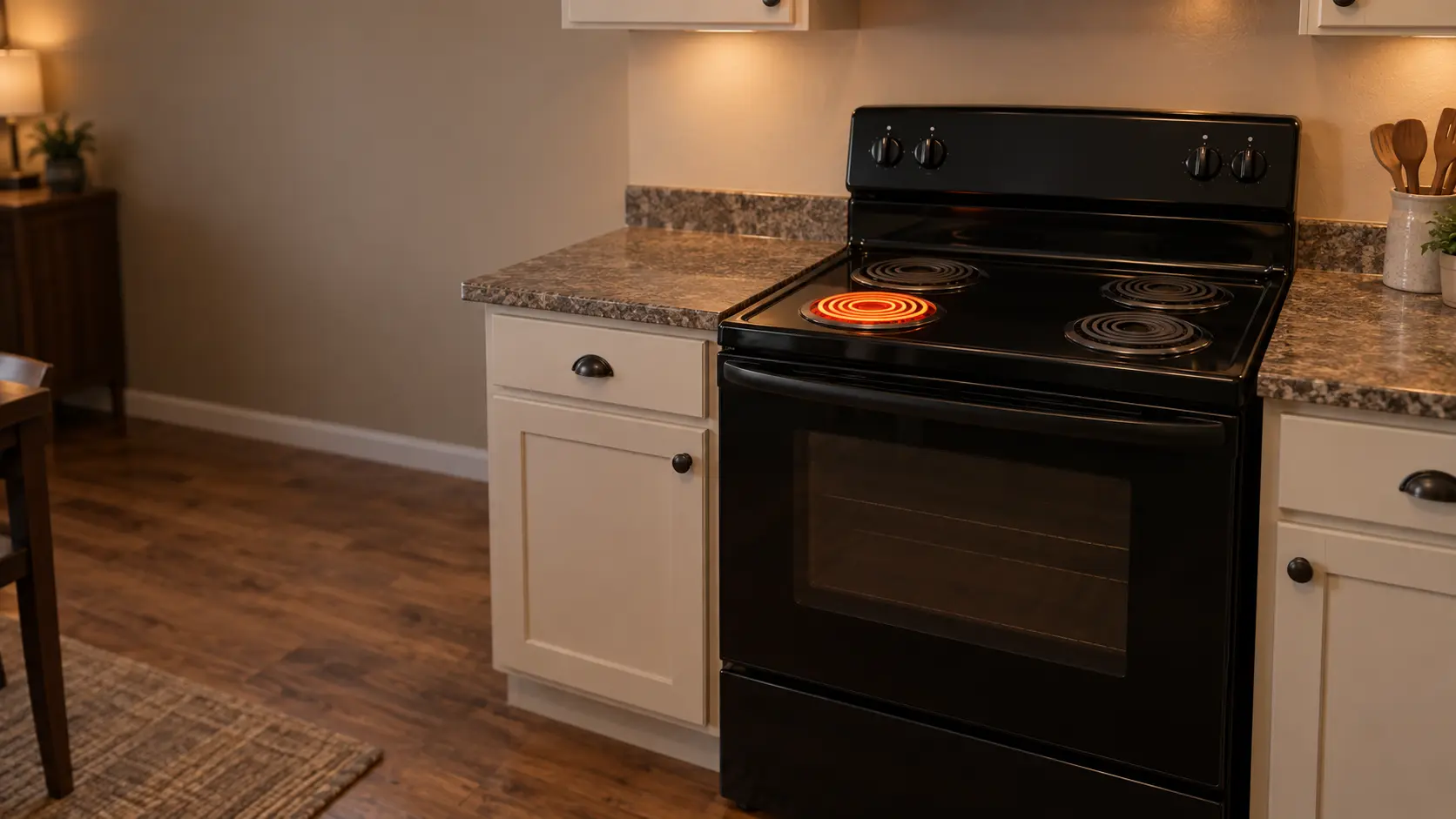
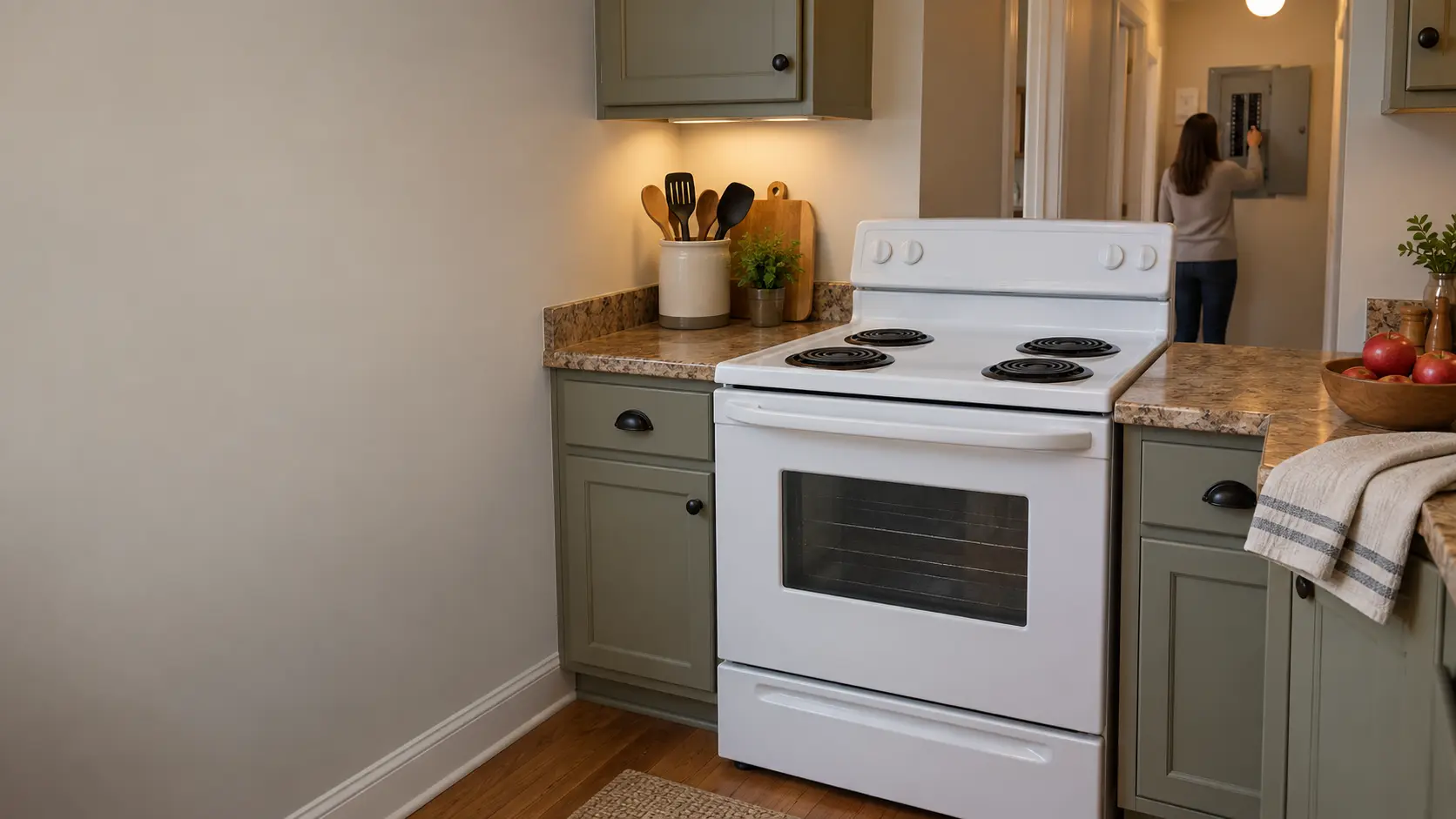
On an electric coil, glass or induction stove, the breaker panel is the off switch that always works. Turn the stove's breaker off and check that the element begins to darken or, on induction, that the zone display goes out. On a gas stove, turn the knob to off; if the flame dies, the knob and valve are working and something else is going on.
- Electric: breaker off, both handles, and leave it off until the stove has been checked.
- Gas, flame goes out with the knob: keep the knob off and do not use that burner until it is looked at.
- Gas, flame keeps burning with the knob at off: do not blow it out, keep people back, and call the gas utility.
- Smoke from the wiring or sparks below the burner: breaker off if the panel can be reached safely, then leave the kitchen.
Source: U.S. Fire Administration — Cooking fire safety — If grease smokes or starts to boil, turn the burner off; cover a pan that catches fire with a lid or baking sheet
Is it really stuck, or is it cycling?
Electric burners do not deliver steady heat the way a gas flame does. GE explains that coil and radiant burners switch on and off even on high, to protect the surface from extreme temperatures, and that on every setting including low they run at full power for stretches of time. On its radiant models, high runs roughly three quarters of the time and low roughly a quarter.
That means a burner on low can glow bright red for a while and look as if it is stuck on high. Watch it for several minutes: a burner that goes dark between bursts is cycling, while one that glows steadily on low and never darkens is not.
Coil burners with a center sensor
GE says that since 2018 its plug-in coil burners carry a sensor button in the center that must touch the pan. When the pan approaches about 450°F the burner switches itself off until the pan cools, then resumes. That cycling is a safety feature, not a stuck switch.
The hot light that outlasts the heat
A glass top holds heat after every element is off, and its warning light is meant to stay lit. GE describes lights that stay on for about 20 to 30 minutes, some timed and some sensing the glass. Only a light still glowing after 45 minutes to an hour, with every burner off and cool, is a reason to disconnect power and call.
Source: GE Appliances — Surface burners cycle on and off — Coil and radiant burners cycle even on high, and run at 100% power for periods on every setting including low; GE Appliances — Radiant burner turns on and off — High cycles about 75% on, medium about 50%, low about 25%

What fails when heat will not come down
Each kind of stove has its own part that decides how much heat reaches the burner, and each can fail in a way that leaves the burner at full power. Knowing which part it is tells you why the knob no longer matters.
Coil and glass stoves with knobs
Behind each knob sits a switch that clicks the burner on and off in timed bursts. Its contacts carry heavy current, and with age they can pit and weld together so that power flows continuously. The burner then runs at full heat on any setting and often keeps heating with the knob at off. The switch is a replaceable part, but it is wired to 240 volts.
Touch-control glass and induction stoves
Here the switching happens on a control board, through relays or power electronics. A relay whose contacts have stuck behaves like a welded knob switch, and a board with a failed component may ignore the off key entirely. These boards are model-specific, so the model number decides how quickly the part can be found.
Gas stoves
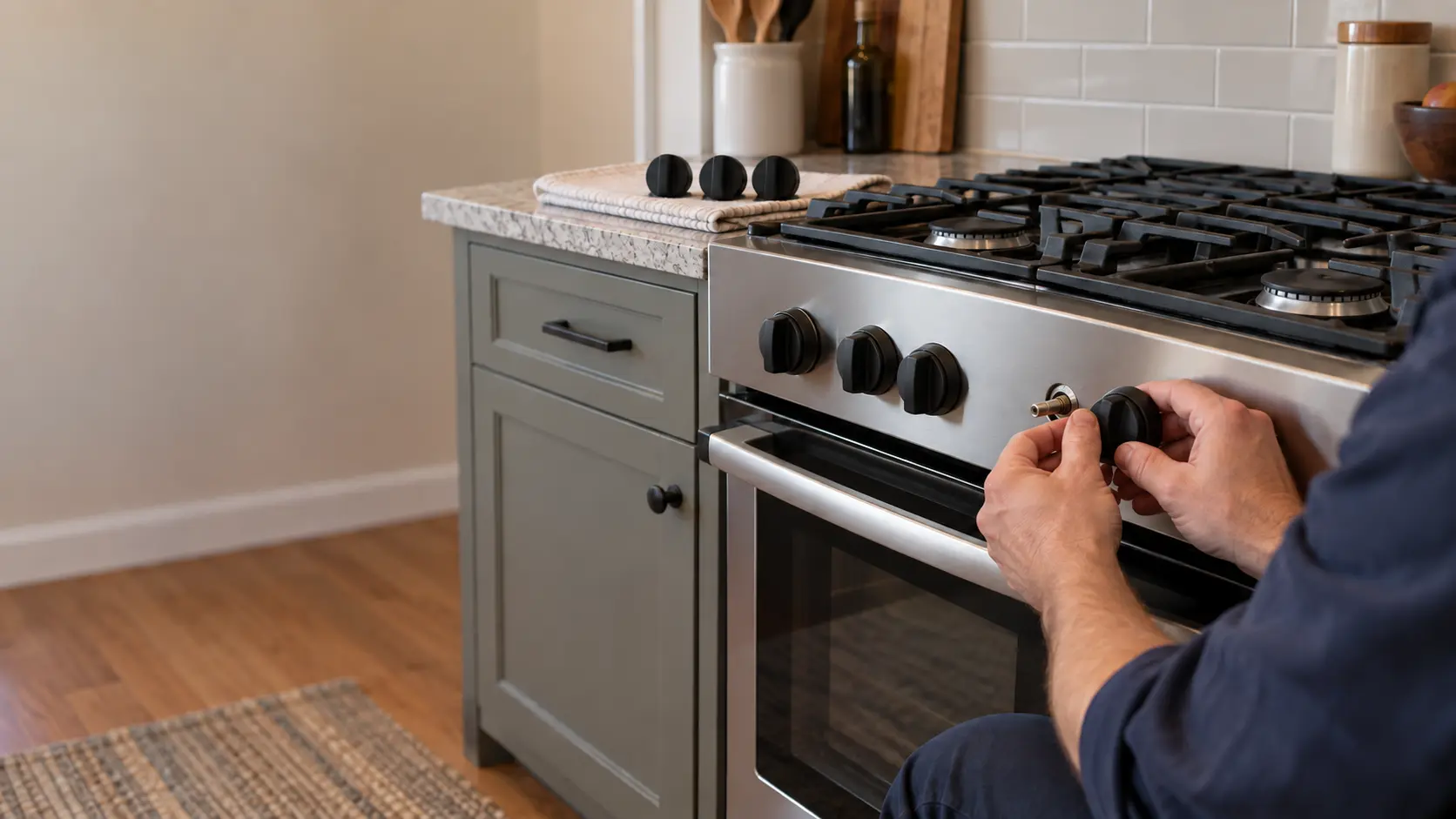
On gas, a flame stuck at full size usually comes from a knob that slipped on its shaft, so its pointer no longer matches the valve, or from a valve that has stiffened. GE lists controls that are hard to turn as a reason to call service. A valve that will not close is gas work, and never an owner's repair.
Heat that only feels stuck
Some stoves run hotter around a burner without anything being wrong with the switch. On coil models GE points to pans that overhang the burner by more than an inch, drip pans lined with foil, dark drip pans that pass more heat to the top, and an oven vent under a rear burner that has been turned the wrong way. Each makes the top of the stove feel as though a burner is stuck high.
- Pan much wider than the coil: step down to a pan no more than an inch wider on each side.
- Foil in the drip bowls: take it out.
- Oven on at the same time: the rear burner over the vent will feel hotter.
- Decorative cover on a rear coil: remove it while the oven is in use.
Source: GE Appliances — Surface seems too hot on coil burner models — Pans should not overhang more than one inch; foil-covered or dark drip pans and a misplaced or covered oven vent send more heat to the top
Before the breaker goes back on
Once the heat is off, resist testing the burner again to see if it cured itself. A welded contact can release when cool and weld again the next time, so a stove that behaves for a day has not been fixed. Leave the breaker off, or on a gas stove leave that burner unused, until someone has checked the switch or valve.
Before the visit, note which burner it was, what setting the knob was at, whether the burner kept heating with the knob at off, and whether it happened once or keeps coming back. Those four details usually point straight at the part.