While the power is still out
The moment the lights go, turn every burner knob and the oven to off. GE points out that an electric stove with knobs will switch its burners back on when power returns if the knobs were left on, which can mean a pan heating in an empty house. Ready.gov also advises disconnecting appliances to avoid damage from surges; for an electric stove, the practical way to do that is to switch its breaker off until the power has been back and steady for a few minutes.
Ready.gov is equally clear on what not to do: never use a gas stove or oven to heat the home, because it raises the risk of carbon monoxide poisoning, and run a generator only outdoors, away from windows. Working carbon monoxide alarms on every level are the backstop.
Gas stoves in the dark
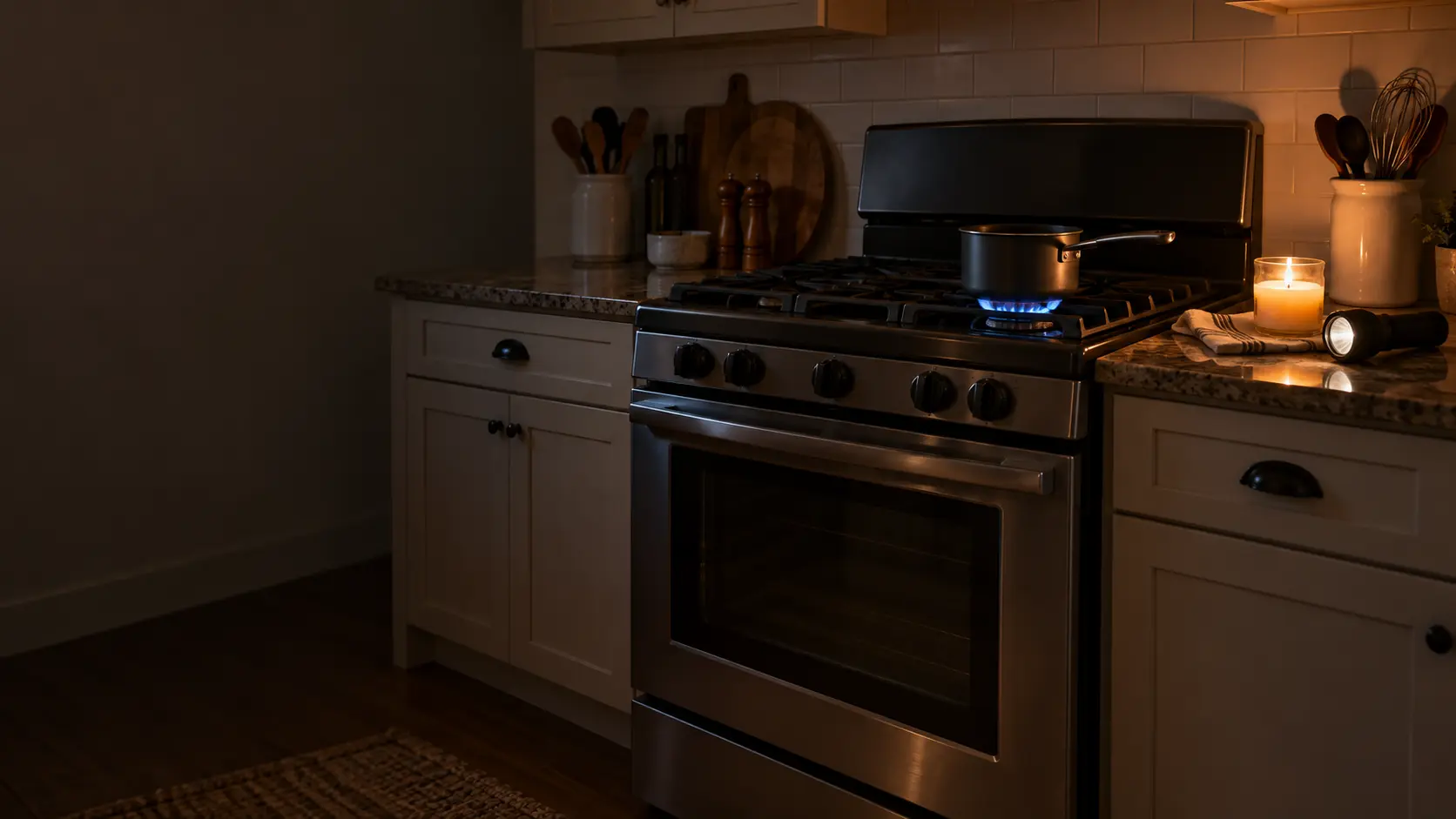
Electric ignition needs power, but the gas itself still flows. GE's instructions for its electric-ignition models are to hold a lit match next to the burner and then turn the knob to low. A burner that was already lit when the power failed stays lit. The oven cannot be lit by hand at all, because its igniter and gas valve need electricity to open, so plan on burner cooking only. Check your own manual before trying this, and never leave a burner turned on unlit.
Electric and induction stoves in the dark
Coil, glass and induction stoves cannot cook at all without power. On touch-control models GE notes that the burners will not come back on by themselves when power returns, but knob models will, which is why the knobs go to off first. A glass top stays hot for a while after the outage starts, so keep hands and plastic off it.
Source: Ready.gov — Power outages — Disconnect appliances to avoid surge damage; do not use a gas stove or oven to heat the home (carbon monoxide); generators only outdoors away from windows; CO detectors on every level; GE Appliances — Power outage tips and operation — Clock and oven settings are lost; knob-controlled electric burners must be turned off so they do not come back on, touch-control ones do not; electric ovens cannot be used in an outage
The first ten minutes after the lights come back
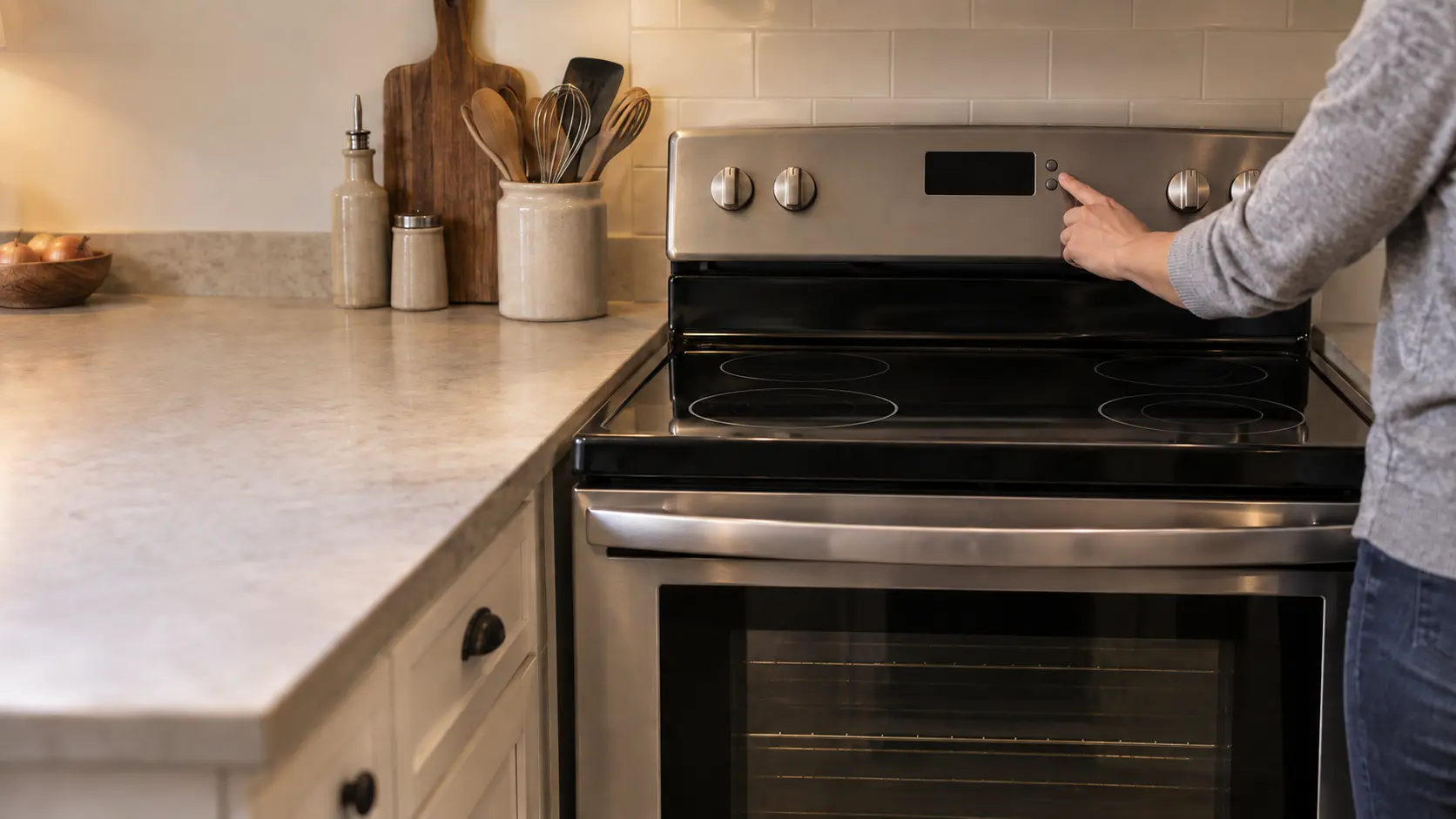
Turn the stove's breaker back on if you switched it off, and look at the display. Checking a stove after a power outage mostly means noticing what it forgot: a flashing time, zeros or dashes simply mean the clock lost its setting, and GE says its stoves do not keep the time or oven settings through an outage. Set the clock using the manual's steps, then try a short bake at a normal temperature and light or switch on each burner in turn.
Anything that was cooking when the power failed will not resume. GE explains that the oven turns off and stays off, and the mode, temperature and timer have to be entered again.
A display that stays blank or half-lit
If the display stays dark while the house has power, or shows numbers with segments missing, cut the stove's power for about 30 seconds and restore it. GE recommends that reset for both a blank clock and a display showing partial characters; if the second one persists after the reset, the display or its board needs service.
An oven that refuses to start
On some models the oven functions stay locked until the time of day has been set, which after an outage can look like a failed oven. Setting the clock is the cure. If the oven still ignores every key, look for a lock symbol that a surge or a curious hand may have left behind.
Source: GE Appliances — Power outage tips and operation — Clock and oven settings are lost; knob-controlled electric burners must be turned off so they do not come back on, touch-control ones do not; electric ovens cannot be used in an outage; GE Appliances — Lighting electric ignition burners during a power failure — Hold a lit match next to the burner, then turn to low; a lit burner stays lit; the oven cannot be lit manually and will not resume after the outage

Signs the outage left something behind
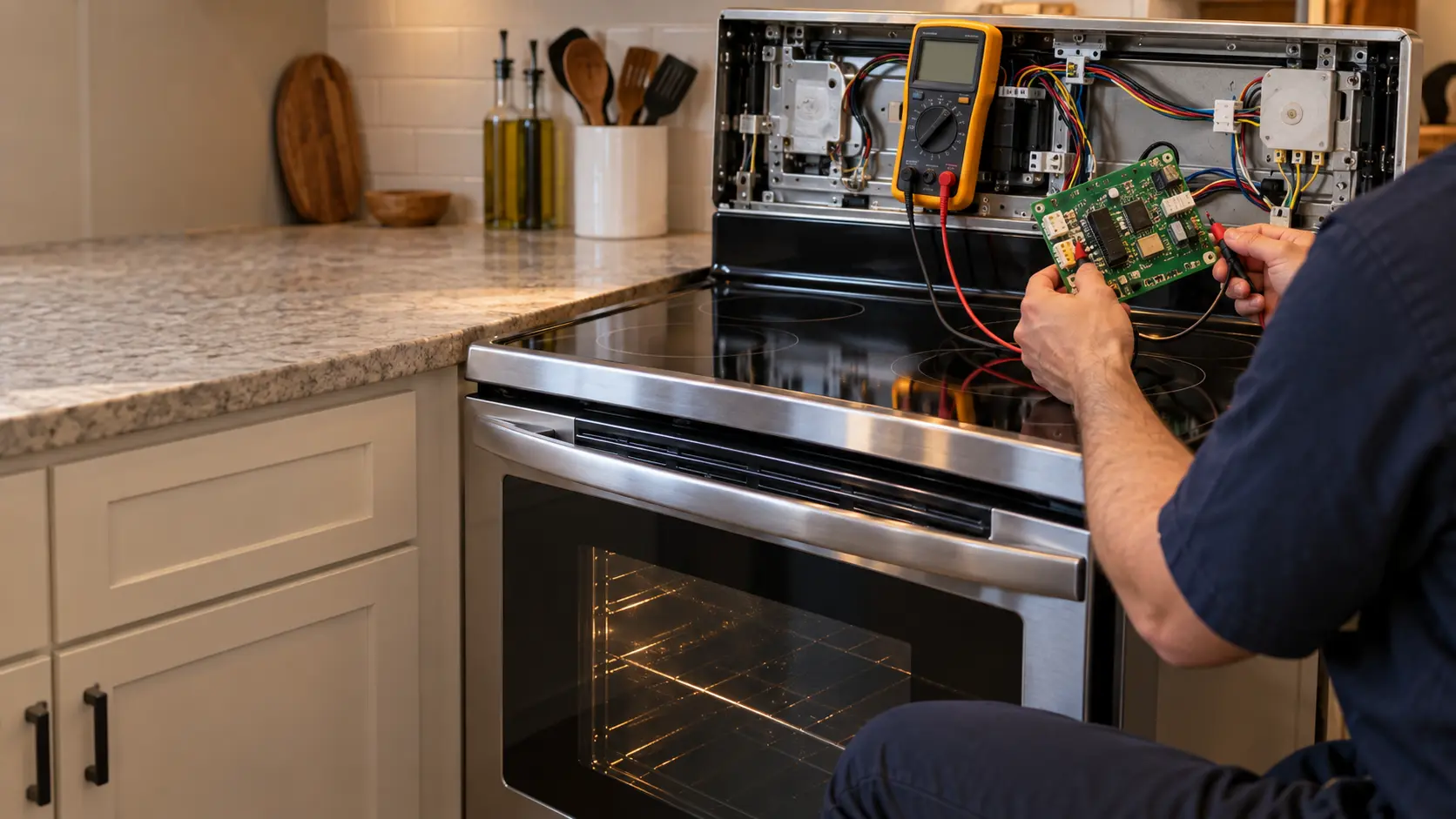
Brownouts and the surge when service is restored are hard on electronics and on breakers. Most stoves come through untouched, but the following are worth noticing on the first day, because they point to a supply or board issue rather than to a stove that merely forgot its settings.
- Clock works but every electric burner heats weakly or not at all: GE ties that to partial voltage, often one half of a two-pole breaker.
- An electric stove that shows lights and features but will not heat: GE's demo mode appears when a model receives only partial power.
- A burning or hot-plastic smell from the back panel when power returned: switch the breaker off and leave it off.
- Igniters clicking with every knob off since the outage: turn the breaker off and have the spark switches checked.
- A breaker that trips again as soon as it is reset: stop resetting it.
Source: GE Appliances — Electric models: check the power supply — With partial voltage the clock may work while burners do not heat properly; GE Appliances — Stuck in demo mode — Partial power can trigger demo mode on electric models
The food that was in the kitchen
A dish that was halfway through baking when the oven died has been sitting in a cooling oven, and the same rules apply to it as to food on the counter. FDA's power-outage guidance says to discard perishable food such as meat, poultry, fish, eggs and leftovers that has been above 40°F for two hours or more, and its separate outage page gives the same two-hour limit for food held at room temperature.
The refrigerator next to the stove buys time only if it stays shut. FDA says an unopened refrigerator keeps food cold for about 4 hours, so resist opening it to find something to cook on the gas burners.
Source: FDA — Food and water safety during power outages and floods — Discard perishable food held at room temperature for 2 hours or more; FDA — Power outages: key tips for consumers about food safety — Discard perishables above 40°F for two hours or more; an unopened refrigerator keeps food cold for about 4 hours
Older and heritage stoves
Stoves without electronics ride out an outage better than new ones. A decades-old gas stove with a standing pilot needs no electricity for its burners at all, though its oven may still depend on a power-hungry igniter or clock. Older electric stoves with a mechanical clock may simply show the wrong time afterward.
Heritage stoves built in Europe vary widely: some are almost entirely mechanical, others carry full electronic controls. Their manuals describe outage behavior for each model, and it is worth reading that page before the next storm rather than during it.
- Standing-pilot gas stove: check that each pilot is still burning once the outage ends, and call the gas utility if one is out and you smell gas.
- Mechanical clock: reset the hands; the burners and oven were never affected.
- Heritage stove with electronic controls: follow its manual's restart steps before cooking.


