

Lighten it and clear the path
Moving a stove starts with a cold stove that has been off for at least an hour. Take out everything loose: the grates and burner caps on a gas stove, the oven racks, the broiler pan and the storage drawer, which on many models lifts off its runners. Tape the oven door shut with painter's tape so it cannot swing open on the way, and lay down cardboard, hardboard or an old rug upside down along the path the feet will travel.
The oven door is the heaviest loose part and the one most often damaged. GE's owner's manual shows how its doors lift off their hinges, and warns that the door is very heavy and must never be lifted by the handle. If you take it off, stand it on a towel against a wall, glass side in, where nobody will step on it.
- Grates and burner caps, or coil elements on stoves where they unplug from their sockets.
- Oven racks, the broiler pan and any baking stone.
- The storage drawer, lifted off its runners.
- Knobs, if they slide off, sealed in a bag so none goes missing.
Cast-iron and other heritage stoves
A cast-iron heat-storage stove or a heavy European classic is a different job. These are often built into their space, taken apart in sections to move and reassembled by people who know the model, so they are not something to walk out on a dolly. Ask before anyone tries.
Source: GE Appliances — Owner's Manual, Electric Free-Standing Ranges (49-2000951) — The oven door is very heavy and must not be lifted by the handle; door removal with hinge locks; never completely remove the leveling legs; repeat the anti-tip check whenever the stove is pulled from the wall
How far the stove can come out before the line pulls
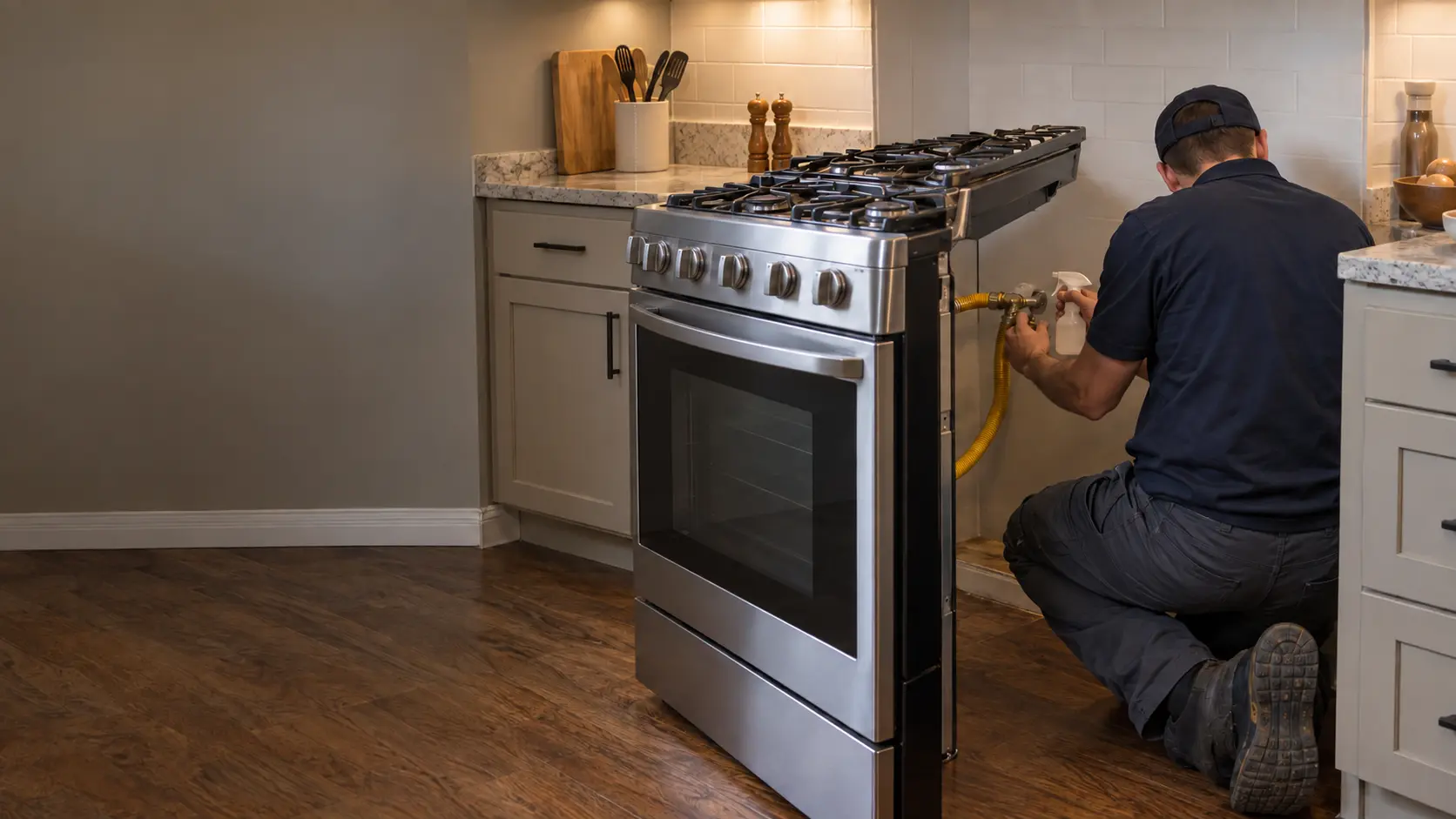
A gas stove is tied to the wall by a flexible metal connector running from a shutoff valve to the back of the stove; an electric stove by a heavy cord to a large wall outlet, or by conduit into a junction box. Either one is only as long as it had to be at installation. Pull the stove forward slowly and in a straight line, look behind it once there is a gap, and stop before anything goes tight.
For cleaning behind the stove, that is usually far enough. If it has to come further, the stove needs to be disconnected. Unplugging an electric stove from its outlet is an owner's job, with the breaker off first; a hardwired stove on conduit is for an electrician.
Slide-in models and the counter edge
A slide-in stove sits between cabinets with its top overlapping the counter on either side. Draw it straight out without twisting; a stove pulled at an angle catches that lip on the counter and chips the edge or bends its own side trim.
Disconnecting gas is a job for the installer
GE's gas installation instructions ask for the main gas supply to be shut off before the old appliance is disconnected, and for it to stay off until the new hookup is finished. They also say never to use an old connector when installing a stove, because old flexible connectors can cause gas leaks, and to check every joint afterwards with a liquid leak detector, never with a flame. Those are the installer's steps, and they are where most moving damage turns dangerous.
Two things an owner should know: where the shutoff valve behind the stove is, and that the other gas appliances in the house may need their pilots relit when the supply comes back on, as GE's instructions remind installers. If you smell gas at any point during a move, leave the house and call the gas utility from outside.
Source: GE Appliances — Installation Instructions, Gas Range (31-2001181) — Shut off the main gas supply before disconnecting and leave it off until the new hookup is done; always use a new flexible connector; leak check with a liquid detector, never a flame; relight pilots on other appliances; synthetic flooring must withstand 180°F; re-engage the anti-tip bracket if moved; burners should light within 4 seconds
Protecting the floor under the stove
Stoves are pushed on four small leveling legs, and on soft vinyl or cushioned floors those legs dig in and tear. Sliding the stove on a sheet of hardboard, or tipping it back slightly onto a two-wheel appliance dolly strapped at the sides, spreads the weight. Never pull on the stovetop edge to rock it; GE's gas stove manual warns that lifting the top can damage the gas tubing to the burners underneath and cause a leak.
If you are laying a new floor, remember what the stove asks of it. GE's installation instructions say that vinyl or other synthetic flooring under a gas stove must withstand 180°F without shrinking, warping or discoloring. A floor that softens under that heat will slowly swallow the leveling legs.
Source: GE Appliances — Installation Instructions, Gas Range (31-2001181) — Shut off the main gas supply before disconnecting and leave it off until the new hookup is done; always use a new flexible connector; leak check with a liquid detector, never a flame; relight pilots on other appliances; synthetic flooring must withstand 180°F; re-engage the anti-tip bracket if moved; burners should light within 4 seconds; GE Appliances — Owner's Manual, Single Oven Gas Ranges (49-2000316) — Do not attempt to lift the top; doing so may damage the gas tubing to the surface burners, causing a leak
Putting it back and checking it
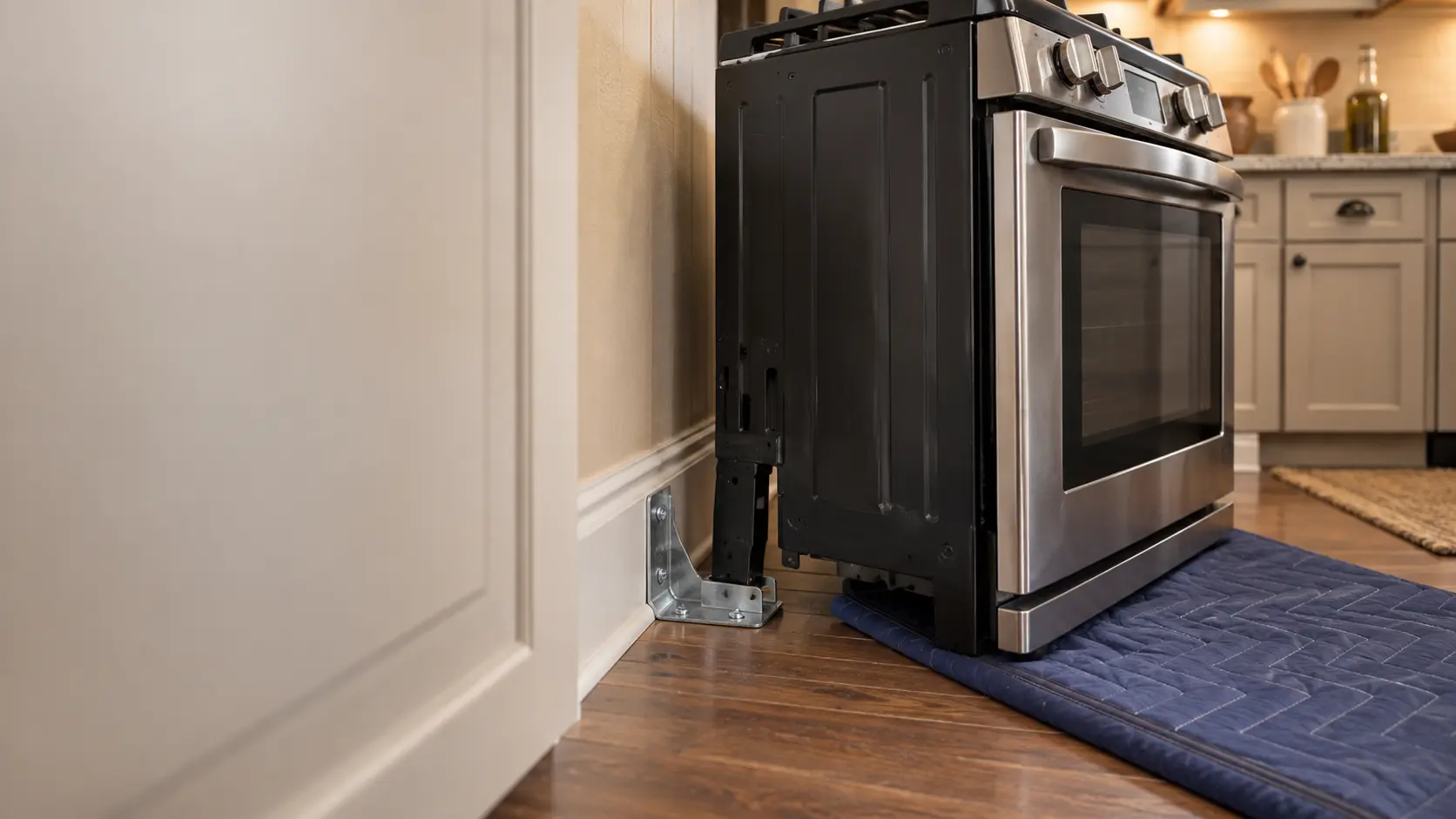
Slide the stove home until the rear leveling leg goes under the anti-tip bracket; GE's instructions say to re-engage the bracket whenever the stove has been moved, and not to remove the leveling legs, because the stove will not be secured without them. Level it with a spirit level on an oven rack, front to back and side to side, then refit the door, racks and drawer.
Then test it the way the installer would. On gas, each burner should light within a few seconds once air has been purged from the line, GE says within four, with a soft blue flame. On electric, each element should heat and the oven should preheat normally. A burner that will not light or an element that stays cold after a move often means a plug not fully seated or a wire pulled at the back, which is a visit rather than a guess.
- The rear leveling leg sits under the anti-tip bracket.
- The stove is level on an oven rack in both directions.
- Each burner lights or each element heats, one at a time.
- The oven preheats and the clock keeps time.
- There is no gas smell around the back of the stove.
Source: GE Appliances — Installation Instructions, Gas Range (31-2001181) — Shut off the main gas supply before disconnecting and leave it off until the new hookup is done; always use a new flexible connector; leak check with a liquid detector, never a flame; relight pilots on other appliances; synthetic flooring must withstand 180°F; re-engage the anti-tip bracket if moved; burners should light within 4 seconds; GE Appliances — Owner's Manual, Electric Free-Standing Ranges (49-2000951) — The oven door is very heavy and must not be lifted by the handle; door removal with hinge locks; never completely remove the leveling legs; repeat the anti-tip check whenever the stove is pulled from the wall
Taking the stove to a new home
Before you pack the stove, find out what the new kitchen offers. A gas stove set up for natural gas will not run on propane without a conversion, which is technician work, and an electric stove's cord has to match the outlet in the new wall, three-slot or four-slot. Moving into a house that has neither the right gas type nor the right outlet can turn a free stove into an expensive one.
Pack the knobs in a labeled bag, keep the manual with the stove, and transport it upright. Glass stovetops travel best with a sheet of cardboard taped over them and nothing stacked on top.
When the stove stays with the house
If the stove is part of the sale, leave its manual in the drawer and show the buyer where the gas shutoff or the breaker is. A stove disconnected for inspections or painting should be hooked up again by the same kind of person who took it off.


