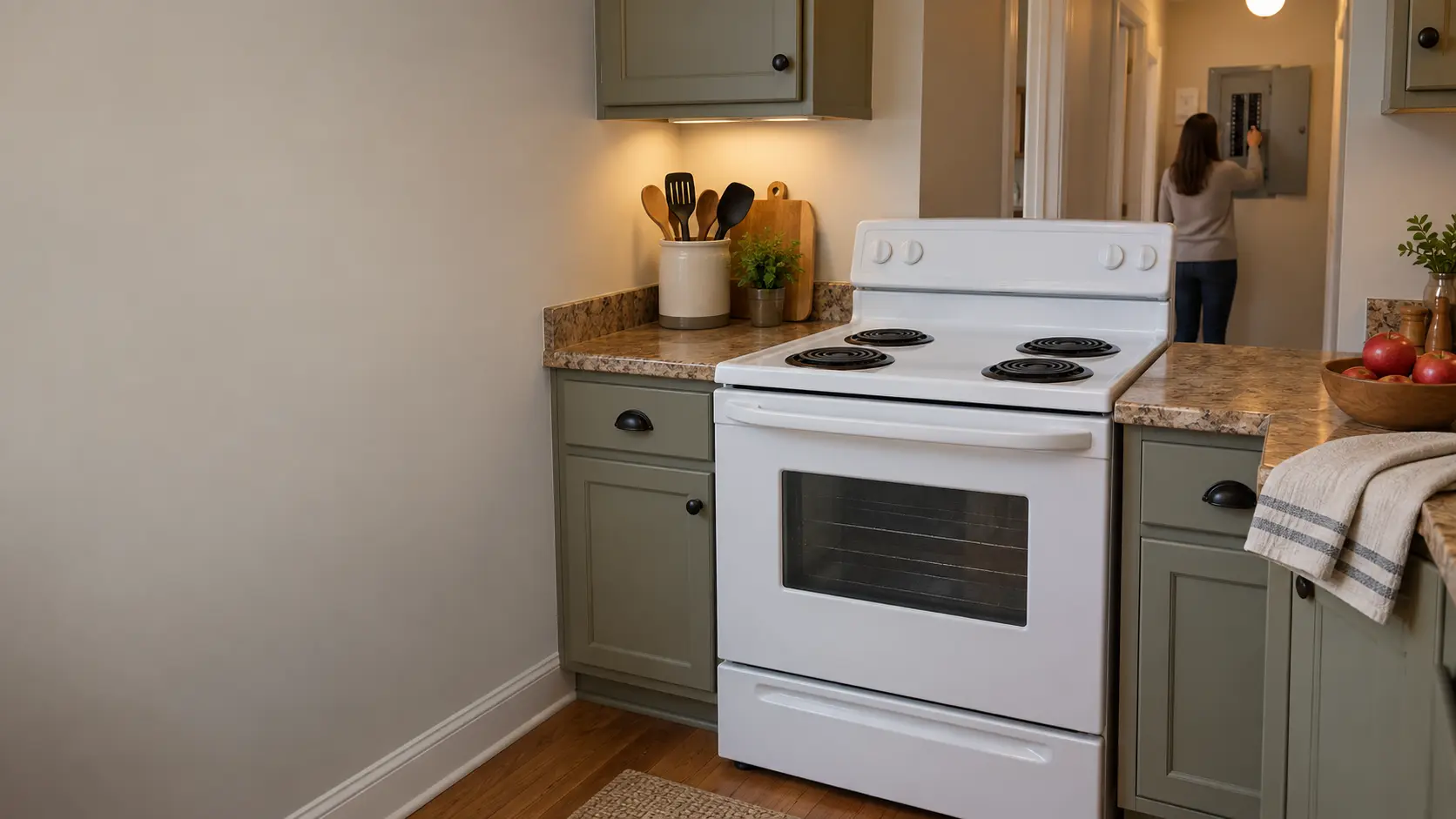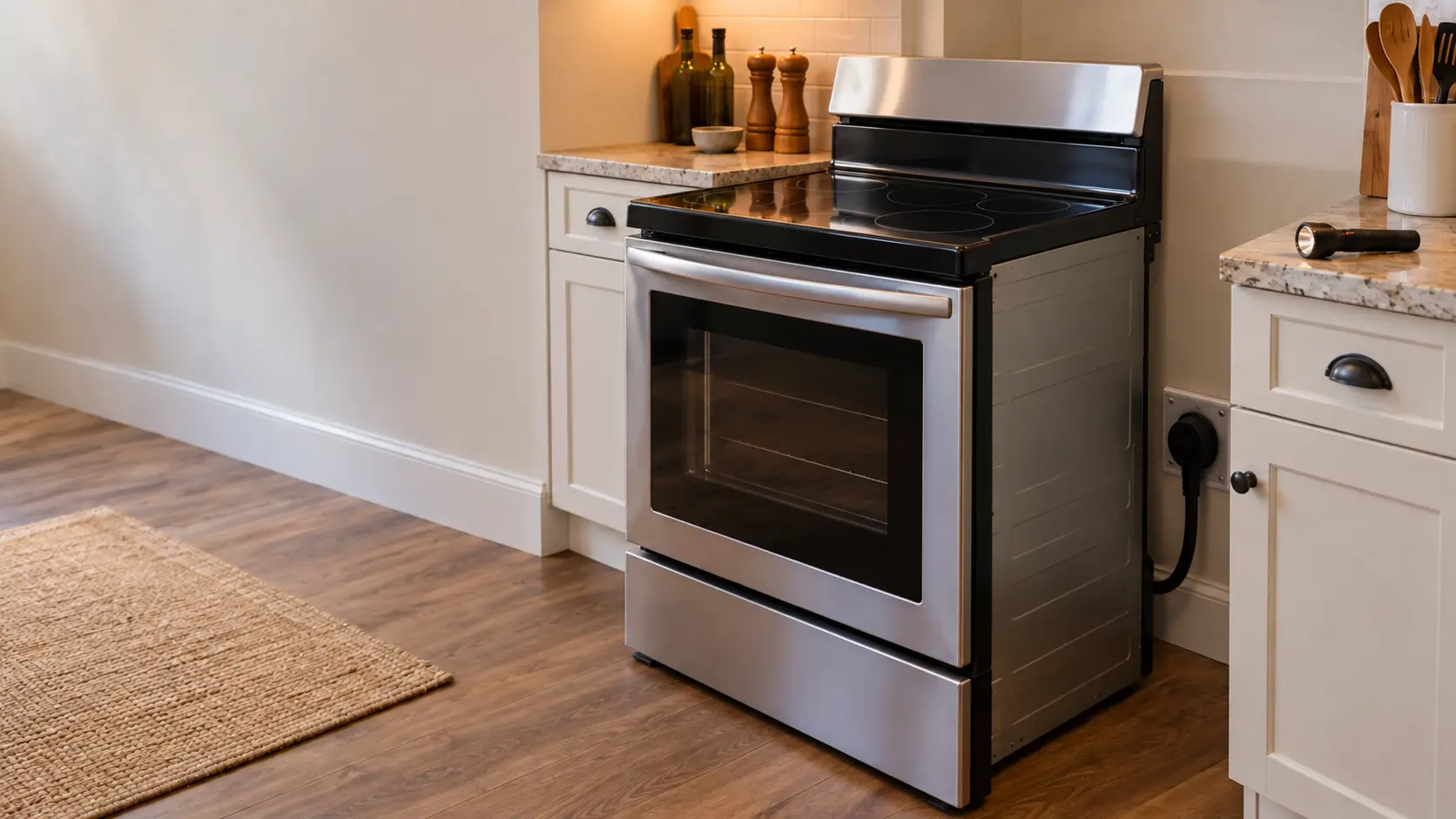

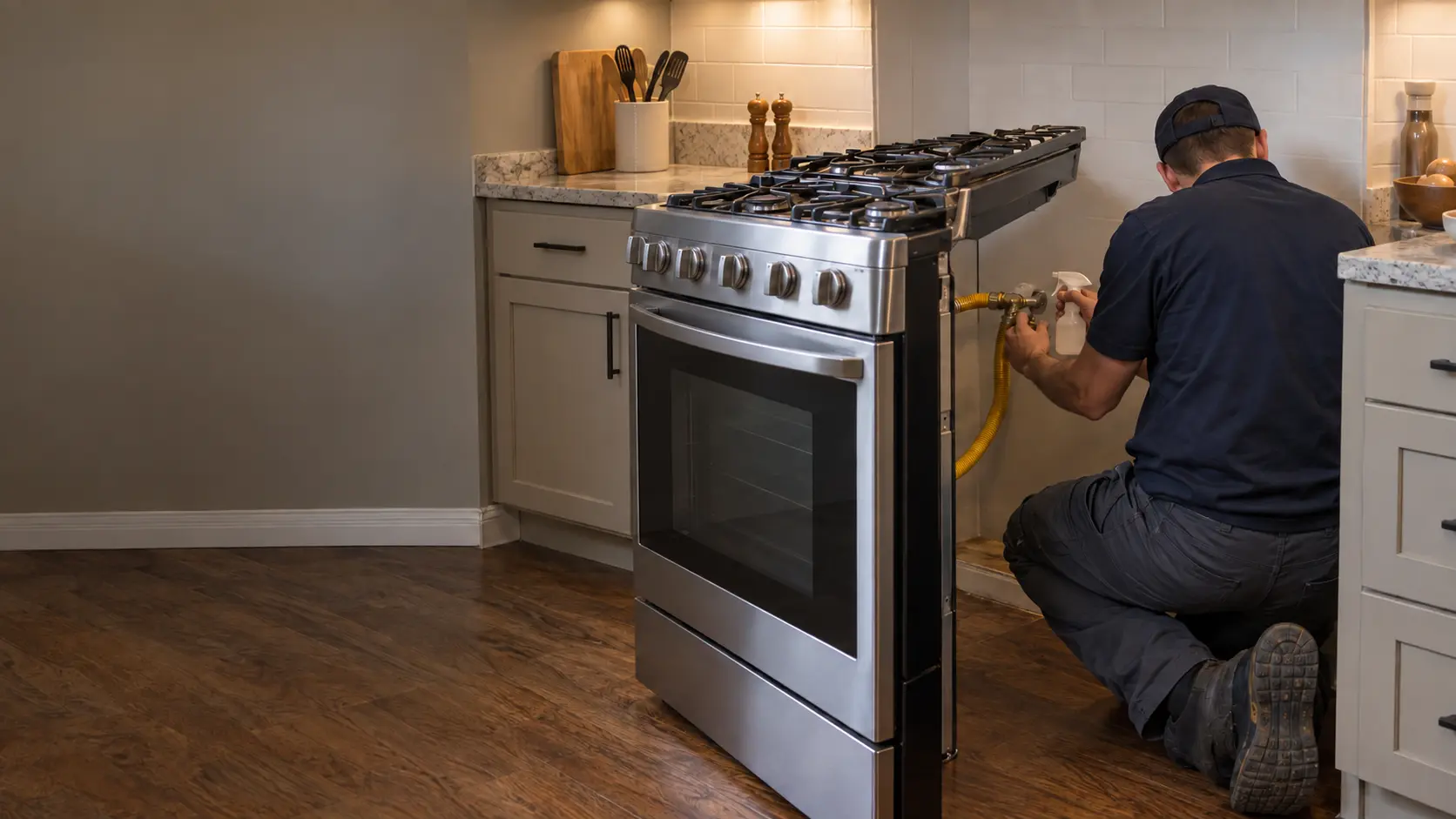
Two very different plugs behind two kinds of stove
A gas stove still needs electricity, but only a little: for the spark igniters, the oven's glow-bar or electronic ignition, the clock and the light. GE's gas stove instructions call for a 120-volt, properly grounded outlet on a dedicated circuit protected by a 15-amp or 20-amp breaker or time-delay fuse. The plug looks like any three-prong household plug, just on a longer, sturdier cord.
An electric or induction stove draws far more and uses a different world of hardware. The cord is as thick as a garden hose, ends in a large plug with three or four heavy blades, and goes into a big round-faced or rectangular outlet near the floor. Some stoves have no plug at all and are wired through flexible metal conduit to a junction box in the wall, which is normal but means the stove cannot simply be unplugged.
Stoves wired in with conduit
A hardwired stove has a flexible metal conduit where a cord would be, running from its back panel to a junction box in the wall. Judge it the way you would a cord: not crushed, not bent sharply, and still clamped at both ends. With no plug to pull, the breaker is the only way to cut its power.
Source: GE Appliances — Installation Instructions, Gas Range (31-2001181) — 120-volt grounded dedicated circuit on a 15- or 20-amp breaker or time-delay fuse; three-prong grounding plug; do not cut the ground prong, use an adapter or an extension cord; a two-prong outlet must be replaced by the customer; GFCI not required or recommended, nuisance tripping possible; external power switches not recommended
What the electric stove's cord should be
GE's electric stove instructions ask for a UL-listed three- or four-conductor cord for this purpose, rated at least 40 amps and 125/250 volts, and an individual, properly grounded branch circuit of at least 40 amps. They add that since January 1, 1996 the National Electrical Code has required the four-wire connection in new construction, and that four wires are also required in mobile homes, recreational vehicles and wherever local codes do not allow grounding through the neutral.
Where the cord enters the back of the stove there should be a strain relief clamp holding it firmly, so that pulling on the cord does not pull on the terminal screws inside. GE's instructions ask installers to center the cord in that clamp so the metal edge cannot cut into it. A cord that flops loose at the back, or has no clamp at all, is the first thing to point out when you book.
The label that says what the stove needs
The stove's own rating label lists its voltage and power, and it is the figure an electrician works from. On GE's freestanding electric models it sits on the oven frame above the storage drawer, visible with the drawer pulled out; other makers put it in the same area or inside the oven door frame.
Source: GE Appliances — Installation Instructions, Free-Standing and Front Control Electric Ranges (31-2000911) — UL-listed three- or four-conductor cord rated at least 40 amps, 125/250 volts; individual grounded 40-amp minimum circuit; four-wire required in new construction since January 1, 1996, mobile homes, RVs and where codes forbid grounding through the neutral; no extension cord; center the cord in the strain relief; rating label on the oven frame above the storage drawer

What a healthy setup looks like with the flashlight
Checking the stove cord and outlet takes a flashlight and a switched-off breaker. Switch the stove's breaker off, pull the storage drawer out or ease the stove forward a little, and look. You are checking by eye only; nothing gets unscrewed.
Signs that all is well:
- The plug is pushed all the way into the outlet, with no metal of the blades showing.
- The plug, the outlet face and the wall plate are their original color, with no browning, bubbling or soot.
- The cord runs in a loose loop, not stretched tight and not folded sharply behind the stove.
- Nothing is resting on the cord: no leveling leg, no drawer runner, no pan that fell back there.
- The outlet sits firmly in the wall and does not move when the plug is touched.
- On a gas stove, a normal three-prong plug with all three prongs, straight into the outlet.
Signs that the cord or outlet needs attention
Heat is the main enemy of a stove connection. A plug that is not fully seated, or an outlet whose contacts have loosened, makes a poor connection that warms up under load, and the warmth slowly chars the plastic around it. By the time someone smells hot plastic while the oven preheats, the damage has usually been building for a while.
Other signs are mechanical. GE's troubleshooting table lists a storage drawer that will not close because the power cord is in the way, which is also how cords get pinched and scraped over time. A gas stove plugged into a two-prong outlet through an adapter, or into an extension cord, breaks two of GE's plain rules: its instructions say not to use an adapter or an extension cord and never to cut or remove the ground prong, and that a two-prong wall outlet is the customer's responsibility to have replaced with a properly grounded three-prong one.
- Brown or black marks on the plug, the outlet or the wall around it.
- A plug or cord that feels warm after cooking.
- A smell of hot plastic or a crackle from behind the stove.
- A breaker that trips when the oven or a large element comes on.
- A tingle when touching the stove and a metal pan or the sink at once.
A gas stove on a GFCI outlet that trips
GE notes that a GFCI-protected outlet is neither required nor recommended for its gas stoves; the stove works on one, but occasional nuisance tripping is possible. It also advises against automatic, wireless or wired external switches that cut power to the stove. If the clock keeps resetting and the outlet has test and reset buttons, that may be the reason.
Source: GE Appliances — Installation Instructions, Gas Range (31-2001181) — 120-volt grounded dedicated circuit on a 15- or 20-amp breaker or time-delay fuse; three-prong grounding plug; do not cut the ground prong, use an adapter or an extension cord; a two-prong outlet must be replaced by the customer; GFCI not required or recommended, nuisance tripping possible; external power switches not recommended; GE Appliances — Owner's Manual, Electric Free-Standing Ranges (49-2000951) — Storage drawer won't close: the power cord may be obstructing it