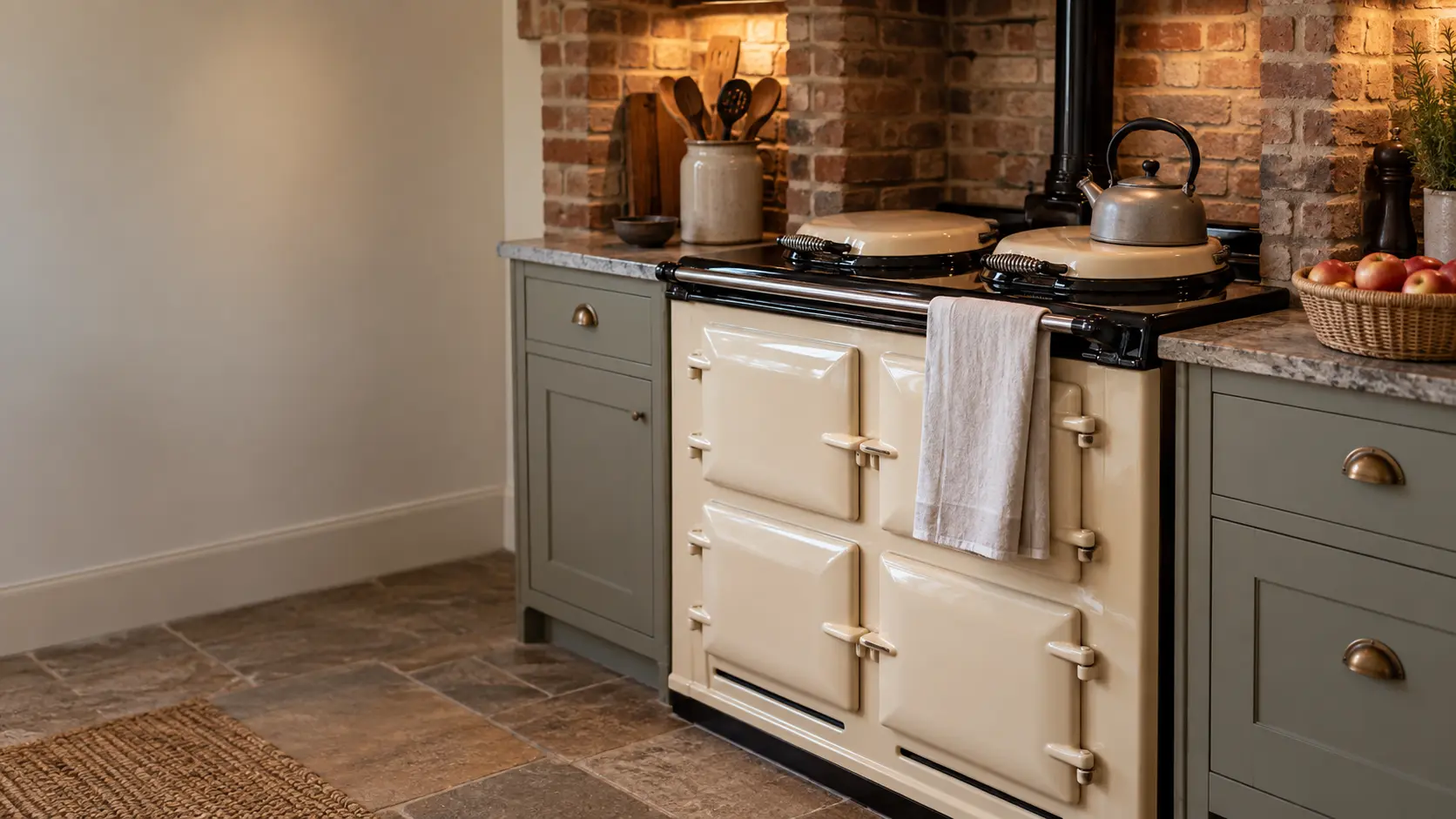


What owners mean by a heritage stove
The word covers stoves that are sold on lineage and craft rather than on the latest feature list. Their owners usually call them simply the stove, or by the maker's name, and many of them arrive in American kitchens through a single importer and a small dealer network. Three families come up most often.
AGA and the heat-storage stove
The AGA is the true cast iron stove of the group. Its ovens are thick cast iron that soaks up heat and gives it back slowly, and its round hotplates under insulated lids do the boiling and simmering. The US lineup shown on AGA's American site includes the R7 and eR7 models, some with induction or a dual-fuel module beside the cast-iron ovens.
La Cornue and the French made-to-order stove
La Cornue presents itself as a maker of handcrafted French stoves since 1908. Its best-known models are built to order in chosen colors and trims, and the CornuFé line offers the look in a more standard format. Underneath the enamel and brass, the burners and ovens work like those of other gas and electric stoves.
ILVE and the Italian classic stove
ILVE builds freestanding stoves in Italy in lines such as Majestic and Nostalgie. Nostalgie pairs retro knobs with brass flame spreaders; Majestic comes in widths from 70 to 150 cm with burners, a cast-iron coup de feu plate or induction on top and one or two ovens below.
How a heat-storage cast iron stove cooks
AGA describes its ovens as absorbing and storing heat, then radiating it gently from every inner surface, so food sits in steady warmth rather than in moving hot air. Each oven has its own job: roasting, baking or simmering. A dish that needs fierce heat goes into the roasting oven and moves to the simmering oven to finish, which takes some getting used to and then becomes the whole appeal.
The traditional model is meant to stay ready all day. AGA says its Classic keeps its three ovens ready and brings useful warmth into the kitchen, with four temperature settings including an eco mode, while most current models let the owner switch ovens and hotplates on and off independently. For a kitchen in Texas or Florida, that warmth is a summer consideration worth raising with the dealer.
- Expect a warm-up measured in hours, not minutes, after a stored-heat oven has been switched off.
- Keep the hotplate lids down when the plates are not in use; that is where much of the heat escapes.
- Learn which oven suits which dish before judging the stove on a first roast.
Source: AGA — Why cooking with an AGA is different — AGA's cast-iron ovens absorb and store heat and radiate it from every inner surface; food moves between roasting, baking and simmering ovens; most current models control ovens and hotplates independently; AGA — Which AGA cooker is right for you — The AGA Classic keeps three cast-iron ovens ready and warms the kitchen, with four temperature settings including an eco mode; the AGA Mini is 60 cm wide

What tends to need attention on these stoves
Heritage stoves are built heavily, yet they have the same kinds of working parts as any stove, plus a few of their own. The difference lies less in how often they need a technician and more in how long a part takes to arrive and how few people have seen the inside of one.
Ask the dealer at purchase who services the stove locally and whether that person has worked on your model before. On a heat-storage stove in particular, a technician who knows how the ovens are meant to settle over a day will read an oven temperature complaint very differently from one who expects a dial and a thermostat.
- Controls and thermostats on heat-storage models, which decide how hot each oven holds.
- Burners, spark electrodes and flame spreaders on the gas tops of French and Italian stoves.
- Oven door seals and hinges, which carry heavy doors and lose their fit over the years.
- Chipped enamel, most often around the hotplates, the door edges and the knobs.
- Fans and elements in the conventional ovens added beside the cast-iron ones on newer models.
Living with one in an American kitchen
Weight is the first practical question. Cast iron and heavy steel mean a floor check before delivery and a crew rather than two friends to move it. Width is the second: AGA's smallest model is 60 cm wide and ILVE's Majestic line runs from 70 to 150 cm, which rarely lines up with the 30, 36 and 48-inch openings of American cabinetry, so the kitchen is planned around the stove and not the other way round.
Parts are the third. Most come through the importer, so a part that is not in the country can take weeks. Owners who rely on the stove every day keep the model and serial number on file, ask the dealer which wear parts are stocked locally, and book routine checks before the holidays rather than during them.
Source: AGA — Which AGA cooker is right for you — The AGA Classic keeps three cast-iron ovens ready and warms the kitchen, with four temperature settings including an eco mode; the AGA Mini is 60 cm wide; ILVE — Majestic — Majestic stoves come in widths from 70 cm to 150 cm with gas burners, a cast-iron coup de feu plate or electric tops
Buying or inheriting one secondhand
Older heritage stoves are sold with houses and on the resale market, sometimes after conversion from one fuel to another. A good-looking example can hide an old conversion, a missing part or an oven that no longer holds its heat. Before money changes hands, check:
- The rating plate: model, serial, fuel type and voltage, matched against what the kitchen supplies.
- Whether the stove was converted between fuels, and by whom.
- That every oven reaches heat and every burner or hotplate works.
- The condition of the enamel, the door seals and any hotplate insulation.
- Whether the importer still lists parts for that generation.


