

Start with what stopped, not with the stove's birthday
Owners tend to ask the age question first, yet two stoves of the same age can deserve opposite answers. A twenty-year-old gas stove with one burner that no longer sparks needs a small part and a short visit. A seven-year-old electric stove whose touch panel went dark after a power surge may need a board the maker has already retired. The part decides; the calendar only hints at how easy that part will be to find.
So before comparing prices, narrow the problem down to one of three pictures. Each points in a different direction.
One burner or one element is out
When the rest of the stove cooks normally, the trouble is local: a spark electrode, a clogged burner port, a coil element or the socket it plugs into, a radiant element under the glass, or the switch behind a single knob. These are the cheapest repairs a stove offers, and they almost never justify a new appliance on their own.
The stovetop works but the oven does not
An oven that will not heat on a stove whose burners are fine usually comes down to a bake element, a gas oven igniter, a temperature sensor or the control that runs them. The first three are routine parts. The last one is where age starts to matter, because older electronic controls are the parts most likely to be out of production.
Nothing works at all
A completely dead stove is often not broken. A tripped breaker, a plug worked loose when the stove was pulled out for cleaning, or a control lock left on accounts for a good share of these calls. Rule those out before you decide anything, since a stove that looks finished may simply be unpowered.
How age changes the answer
Age matters mainly through the parts shelf. Stoves built with mechanical knobs, valves and switches keep going for decades because those pieces are simple and widely shared between models. Stoves built around a glass touch panel and a main board depend on one specific electronic part, and once that part is gone from the catalog the stove can become unrepairable while every other piece of it is sound.
Very old stoves are their own case. Owners of a mid-century gas stove often keep it because they love how it cooks and looks, and many of its parts can still be matched or rebuilt. What cannot be improved is its safety design, so a gas stove of that era deserves a careful look at the connector and the burner valves before anyone invests in cosmetics.
- Signs parts are still easy: the model number returns current part listings, the knobs are mechanical, the oven uses a separate bake and broil element.
- Signs parts may be scarce: a board listed as no longer available, a glass top sold only as a used part, a control that exists on a single model year.
- Signs of wear beyond one part: rust along the oven floor seams, heat-darkened wiring at the back panel, a door that no longer closes square.
Four sizes of stove repair
Owners often judge a repair by how dramatic the stove looks, and that is a poor guide. Constant clicking from every burner sounds serious and is often just a damp igniter; a stove that bakes perfectly while showing a code on the display may be heading for a new board. Put the problem into one of these four sizes first, then set it against the price of a new stove:
- Nothing to replace: power restored at the breaker, a child lock switched off, a cap set back square on its burner, an igniter left to dry after a spill. This is the smallest bill a stove can produce.
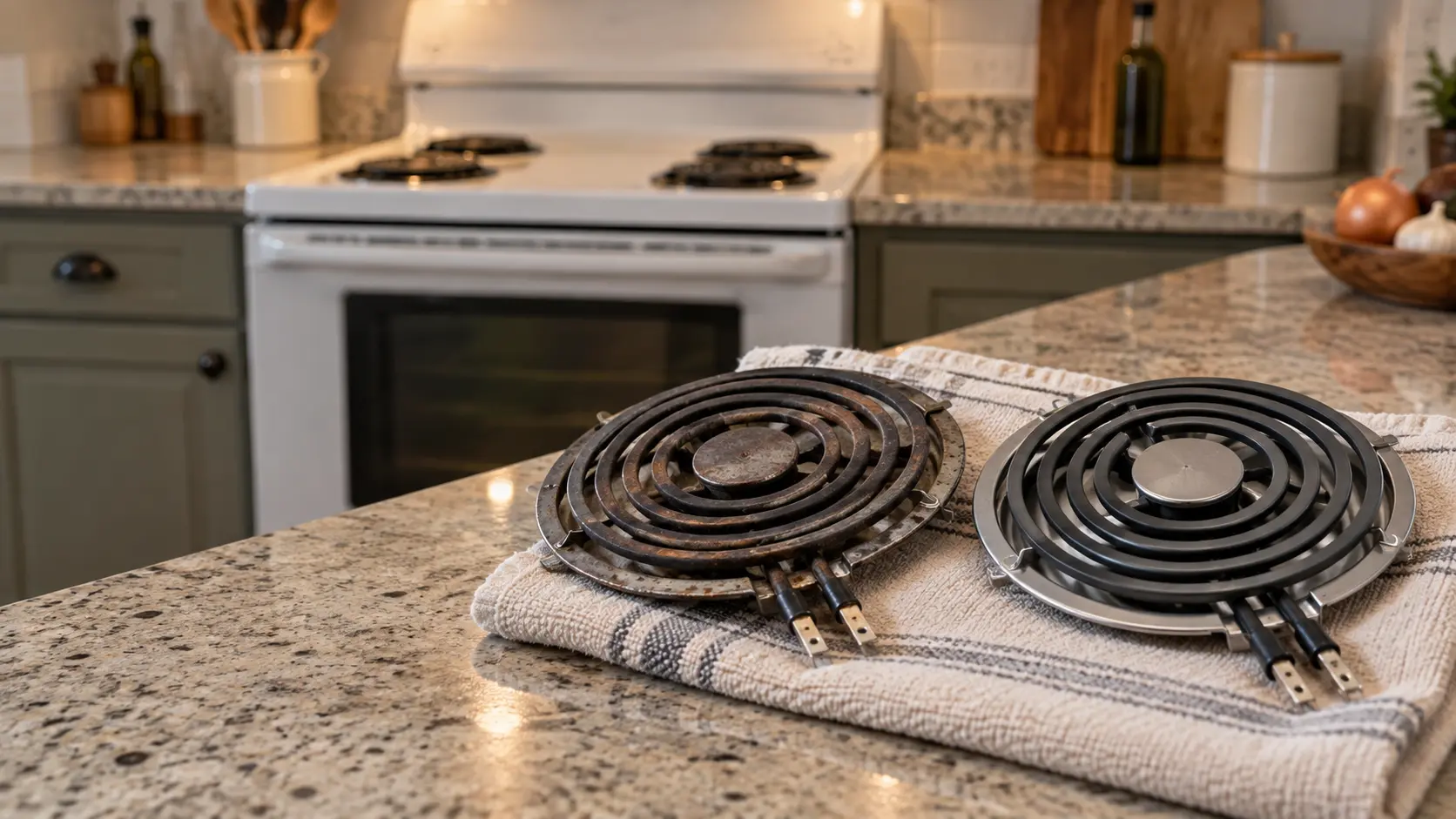
- A single common part: one igniter or spark switch, one coil element or its socket, a knob or the switch it turns.
- A mid-sized job: an oven bake or broil element, a gas oven igniter, the oven temperature sensor, a pair of door hinges, a radiant element under glass.
- The largest repairs: the main control board, a complete glass top, the gas valve assembly, or anything the maker has stopped supplying.
What a new stove brings into the kitchen besides itself
A new stove is rarely a straight swap. A freestanding model has a finished backguard with the controls on top, while a slide-in model sits between the counters with its controls at the front and may leave a strip of wall or an unfinished counter edge exposed where the old backguard used to stand. Widths are standard, but the depth, the height of the stovetop against the counter and the position of the gas inlet or the cord all differ.
A new installation also means a new flexible gas connector or a new power cord, and the anti-tip bracket that came with the old stove will not fit the new one. If the move is from gas to electric or induction, the kitchen needs a heavy 240-volt circuit, sometimes a larger electrical panel, and the gas line capped by a qualified installer. Federal HEEHR rebates, run through the states, can help with efficient electric appliances, wiring and panel upgrades where a state has launched the program.
Source: U.S. Department of Energy — Home Energy Rebates Programs — The HEEHR program offers rebates for efficient electric appliances, electric wiring and load service center upgrades
Findings that close the question
A few findings end the discussion no matter how much the stove cost or how well it has cooked. Before approving any repair, look the model up on the Consumer Product Safety Commission's recall site; when a recall covers it, the maker's remedy is the route, and you should not pay for work the recall already provides.
- Rust eaten through the oven floor or the burner box, usually from years of boil-overs.
- A main board or touch panel no longer made, with no approved substitute.
- Cracked or deeply pitted glass on a model whose top is not sold anymore.
- Scorched, brittle wiring at the terminal block or behind the back panel.
- Several unrelated repairs at once on an entry-level stove, where the total approaches a new one.
Source: CPSC — Recalls and product safety warnings — The Consumer Product Safety Commission publishes product recalls that owners can search by product and brand